


Aeonium haworthii Kiwi is a vibrant, multicolored succulent that instantly brightens any plant collection with its rosettes of soft green, golden yellow, and rosy pink edges. Native to the Canary Islands, this sun-loving species is admired for its cheerful tones that deepen under bright light, giving each rosette a painterly gradient of color. Aeonium Kiwi thrives in mild temperatures and well-draining soil, making it ideal for sunny patios, balconies, or indoor spaces with good light. Its compact form and symmetrical growth pattern make it perfect for container gardens or decorative arrangements alongside other succulents. Beyond its beauty, this plant is remarkably easy to care for requiring only moderate watering and seasonal attention. Whether used as a statement piece, a decorative accent, or a heartfelt gift, Aeonium ‘Kiwi’ captures the joy of nature in a colorful, easygoing form that delights growers of all experience levels.
Our November box featuring Kalanchoe Chocolate Soldier, Echeveria Blue Bird, Crassula Morgan Hybrid W. Silver Springtime, Sedum Little Gem Succulent, and Tillandsia Juncea
1. Kalanchoe Chocolate Soldier
 This listing features our beautiful rooted Kalanchoe Chocolate Soldier or Kalanchoe Tomentosa. 'Chocolate Soldier' is very drought tolerant when established. The velvety leaves are covered with soft tiny hairs that act as a natural shield from hot sunlight. The tips of the yellow/grey-green leaves have slightly raised tooths with rusty brown spots. Kalanchoe Chocolate Soldier has thick stems which become woody with age.
 It produces small, bell-shaped and yellow green flowers in summer.
 Plants may be shipped bare root.
 Full Sun.
 Porous and well-drained.
 Water thoroughly only when soil is dry to the touch, then let drain completely.
 Feed once per month during the growing season.
 Keep out of reach of pets and small children because this plant is toxic when ingested.
2. Echeveria Blue Bird
Echeveria 'Blue Bird' is a beautifully symmetrical succulent with soft, powdery blue foliage and a neat rosette shape. A hybrid variety within the Crassulaceae family, it shares ancestry with Echeveria species native to Mexico, where many evolved under sunny, rocky conditions. 'Blue Bird' forms a single, tight rosette of thick leaves coated in a fine layer of farina, a natural wax that gives the plant its pale, pastel appearance. In bright light, the leaves often take on a silvery-blue tone, sometimes blushing pink at the edges during cooler seasons.
The rosette of the Blue Bird can grow up to 6 to 10 inches wide, with leaves that are broad, pointed, and slightly upturned at the tips. Its uniform, open shape and subtle coloring give it a soft, elegant look compared to more rigid or heavily textured succulents. Mature plants may occasionally produce a tall flower stalk bearing small coral or salmon-pink blooms, although Blue Bird is mainly admired for the beauty of its foliage. The flower spikes add a delicate touch, rising gracefully above the main rosette without disrupting the plant's clean lines.
Compared to similar varieties like Echeveria 'Blue Prince', Blue Bird has a softer, paler color and a more open, airy rosette structure. While Blue Prince tends to have darker, tighter rosettes, Blue Bird maintains a lighter and wider form, giving it a more ethereal presence in succulent displays. Both plants share a powdery coating, but Blue Bird appears more pastel and delicate overall.
Because of its size, form, and delicate color, Echeveria 'Blue Bird' is often used as a centerpiece in succulent bowls or as a gentle contrast among darker or more textured plants. It thrives with good light and minimal watering, making it easy to care for in the right conditions. Like most Echeverias, it does best when left relatively undisturbed, allowing its rosette to develop fully without crowding from nearby plants.
Prefers bright, direct to very bright indirect light for best color and compact growth. Insufficient light can cause the rosette to stretch and lose its shape.
Water thoroughly when the soil is completely dry, making sure to avoid watering directly into the rosette to prevent rot. Reduce watering significantly during the cooler months.
 Adapts best to low to moderate indoor humidity. High humidity can increase the risk of fungal issues, especially if air circulation is poor.
Grows best between 65–80°F. Protect from frost, as freezing temperatures can damage or kill the plant.
 Needs a fast-draining succulent or cactus mix with added perlite or coarse sand. Good drainage is essential to prevent root and crown rot.
Feed lightly once or twice during the growing season with a diluted, low-nitrogen fertilizer. Overfeeding can cause leggy growth and weaken the plant.
Echeveria 'Blue Bird' is considered non-toxic to pets and humans. Still, it’s best to discourage pets from chewing on any plant.
3. Crassula Morgan Hybrid W. Silver Springtime
This species is a hybrid between Crassula "Morgan Beauty" and Crassula "Springtime". It has the silvery coating of Crassula Morgan Beauty, while the dark green color and triangular leaf shape comes from Crassula "Spring Time".
 A compact plant, it can be grown indoors in small containers.
In winter and spring, it produces clusters of tiny soft pink flowers on short stems.
All of the plants may be shipped bare root.
Full sun to partial shade.
Well-Drained, Rich, Gritty.
Water thoroughly when soil is dry to the touch, then let drain completely. Avoid letting water sit for too long in the soil to prevent rot and fungal diseases.
 Average summer temperatures from 65ºF/18ºC to 70ºF/21ºC are ideal. In winter, it can survive temperatures as low as 50ºF/10ºC.
Feed with a controlled-release fertilizer at the beginning of the growing season.
 You can propagate this Crassula hybrid by division, offsets or leaf cuttings. The easiest way is to propagate from a single leaf: put the leaf in a succulent or cacti mix, then cover until it sprouts.
4. Sedum Little Gem Succulent
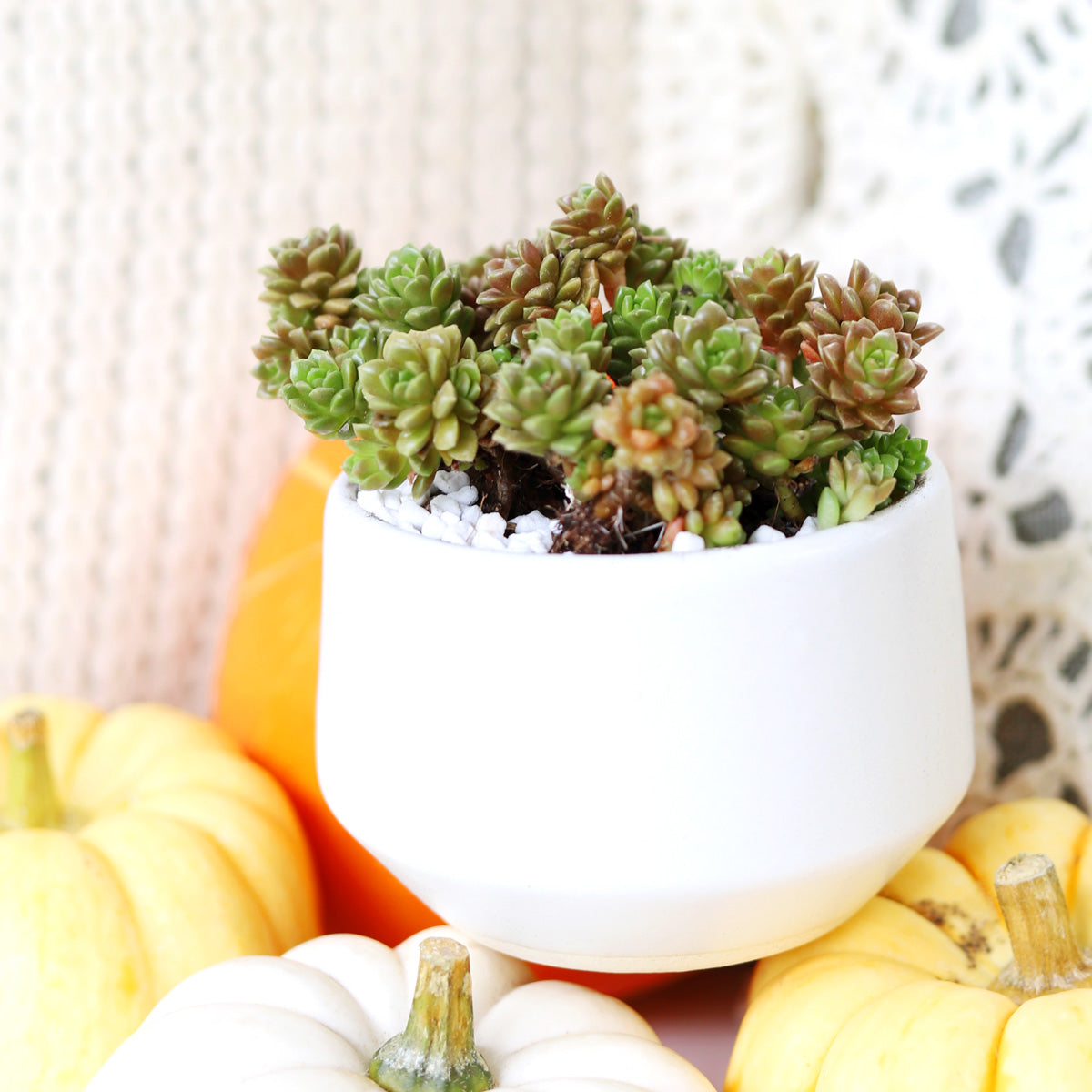
Cremnosedum ‘Little Gem’, hybrid of Sedum and Cremnophlia, forms mats of tiny rosettes of concentric fleshy pointed leaves. Little Gem Sedum is a perfect groundcover that spreads to about 12 inches wide and about 3 inches tall. Rosettes are shiny olive green but turn coppery red in strong light.
Bright yellow star-shaped flowers bloom in late winter and spring.
This succulent is perfect for rock gardens and container plants.
Clay Soil, Sandy Soil, Loamy Soil, Drought/Dry Soil.
Full Sun.
Water deeply when soil is dry to the touch, then let drain completely.
5. Tillandsia Juncea
Tillandsia Juncea, native to American Southern states, Latin America and Antilles, is a drought tolerant and easy to grow air plant. It has long dark grassy-green needle-like leaves and a brown base. Juncea plants sometimes might have a brick red hue as well.
All of the plants may be shipped bare root.
Bright indirect sunlight.
No soil is needed. Sand, sea glass, rocks, pebbles & bark chip can be used instead of soil.
Frequent misting several times a week is necessary. Tillandsia Capitata Peach will also benefit from a soaking bath every week. Give it a little shake off afterwards to make sure water doesn't collect in the bottom leaves to prevent rot.


