


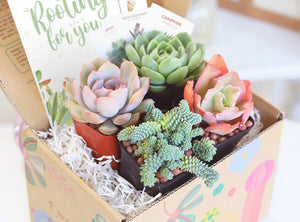
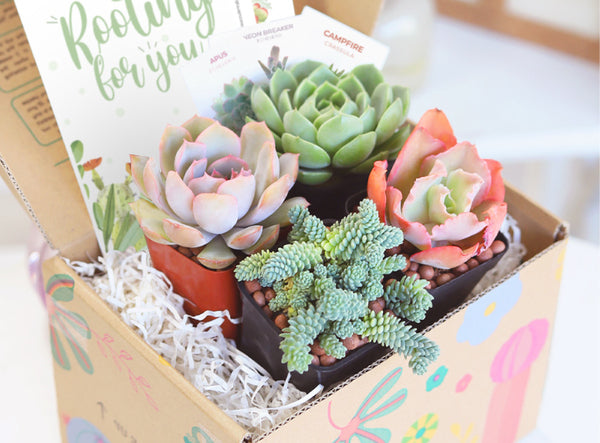


Read on to find out about April Subscription box and their care guide. This month, we feature 4 unique succulent plants: Crassula cotyledonis, Graptoveria ‘Debbie’, Echeveria Fleur Blanc and String of Pearls.
1. Crassula Cotyledonis
 Crassula cotyledonis is a low growing succulent native to South Africa that can reach up to 6 inches (15 cm) tall.
 Its grey green leaves are flat, rounded, paddle-shaped, grown in rosettes and covered with fine short hairs. The leaves have red or purple margins. The whole leaves can also turn vibrant red when stressed in cold temperatures.
 From spring to summer, Crassula cotyledonis produces clusters of small cream-yellow tubular flowers from each stem.
 Full Sun, Sun to Partial Shade, Light Shade.
 Water thoroughly when soil is dry to the touch, then let drain completely. Avoid letting water sit for too long in the soil to prevent rot and fungal diseases. Reduce watering in the winter.
 Porous and well-drained. Optimal pH is around 6.0 (slightly acidic).
 Average summer temperatures from 65ºF/18ºC to 70ºF/21ºC are ideal. In winter, it can survive temperatures as low as 50ºF/10ºC.
 Feed with a controlled-release fertilizer at the beginning of the growing season.
 You can propagate Crassula cotyledonis by division, offsets or leaf cuttings. The easiest way is to propagate from a single leaf: put the leaf in a succulent or cacti mix, then cover until it sprouts.
2. Graptoveria ‘Debbie’
Graptoveria ‘Debbie’ is an Echeveria hybrid with beautiful rosettes of fleshy gray-purple leaves. The tips of these leaves can turn into a vibrant pink color when stressed. Graptoveria ‘Debbie’ offsets readily to for a dense clump. It produces tiny orange flowers in the spring. This plant is perfect to grow in planters outdoors in frost-free areas. it is a tender soft succulent and needs to be protected from frost during the coldest months of winter.
sun. Gritty, Porous and Well-Drained. Water thoroughly when soil is dry to the touch, then let drain completely. Avoid letting water sit for too long in the soil to prevent rot and fungal diseases. Reduce watering to a minimum in the winter. Feed once with a weak fertilizer at the beginning of the growing season (Spring or Summer). You can propagate Graptoveria ‘Debbie' by seeds, leaf cuttings or offsets.
3. Echeveria Fleur Blanc
Echeveria Fleur Blanc grows as an adorable rosette with a wonderful pale green colouring, once potted up it will produce new offsets each one capable of producing beautiful jewel-like bright orange flowers.
 Bright Indirect Sunlight.
 Water succulent when soil is dry 2" deep- usually once a week
 Fast draining soil. Cactus/Succulent mix is best.
 Feed with a controlled-release fertilizer at the beginning of the season.
 Generally non-toxic to humans and animals
4. String of Pearls
Senecio Rowleyanus, native to Namibia, Africa, has pendant stems to 3' or more with unusual round "leaves" giving the impression of a "String of pearls plant". Both the stems and leaves are green. Pearl plant is beautiful in a hanging basket, and can be inside the house in a bright airy room, or outside in a protected patio. Bright light with ample airflow is recommended therefore outdoor in the shade is preferable. Protect from frost. Well-drained soil. Water thoroughly when soil is dry to the touch, then let drain completely. Avoid letting water sit for too long in the soil to prevent rot and fungal diseases. Reduce watering to a minimum in the winter. Small, white flowers that smell like cinnamon. Can be toxic to humans and animals
See more about March 2020 Subscription Box Care Guide
Click here to get all details.
If you found this article interesting, share it with your succulent loving friends!
And get a free plant when your friends make an order. Sign up here!
LeLearn more about how to nurture and enjoy many gorgeous succulents and clever decoration tips with our newsletter. Let's sign up!
Recommended Items


