


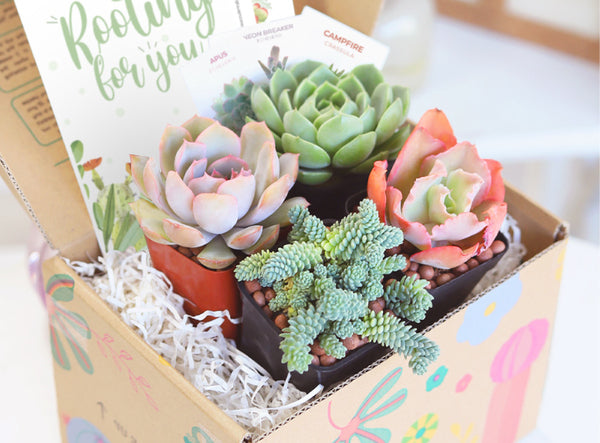
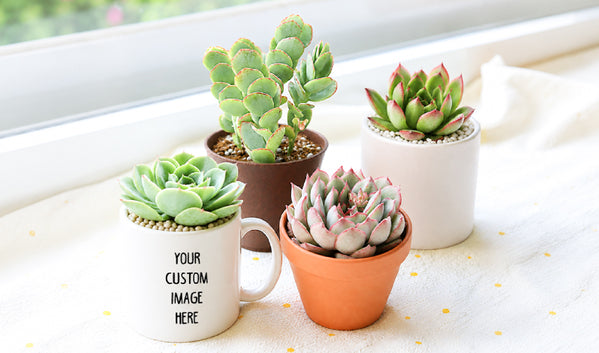



Our January box featuring Cotyledon orbiculata 'Oophylla', Graptopetalum Purple Delight, Sedeveria 'Letizia', Crassula Cotyledonis and Tillandsia Melanocrater Tricolor
1. Cotyledon orbiculata 'Oophylla'

 Cotyledon orbiculata ‘Oophylla’ is a soft succulent with pale silver to nearly white, egg-shaped leaves and thick, upright stems that may branch into a compact shrub. Under bright sun or mild drought stress, the leaf edges can turn deep maroon or purple, adding striking contrast.
 It displays tiny, soft pink, bell-shaped flowers.
 Plants may be shipped bare root.
 Bright Light, Full Sun.
 It grows best in sandy-gritty soil. Good drainage is very important as it is prone to root rot.
 Water the plant when the soil is dry, then let the soil dry before watering again.
2. Graptopetalum Purple Delight
 Graptopetalum Purple Delight or Graptopetalum Snow White is a plant species of the Crassulaceae family. This succulent has perfect purple rosette shape. Its leaves can margin color from lavender-gray to frosy-white under stress.
 When it flowers you can expect it to produce bell-shaped orange flowers. Graptopetalum Purple Delight is a slow-growing succulent species.
Plants may be shipped bare-root with the No Pot option. Option with pots will be shipped with soil.
Well-draining Soil.
Water deeply enough to allow water to flow down the drainage hole, then wait for the soil to dry completely before watering again.
Graptopetalum Snow White thrives well under full sun, bright indoor light. However, avoid direct sunlight to prevent evaporation.
 This succulent thrives in temperatures of 65°F-75°F. It is vital to ensure the room temperature does not fall below 60°F.
 This plant should be fertilized once during the growing season (spring/summer) with diluted houseplant fertilizer.
3. Sedeveria 'Letizia'

Sedeveria ‘Letizia’ is a charming hybrid succulent featuring fresh apple-green rosettes with soft, delicate leaf edges. Under bright sunlight, the leaf margins can blush a vivid red, adding a lovely pop of color to the plant. The rosettes stay compact, while the stems gradually grow taller over time, giving the plant a graceful, upright look.
In spring, Sedeveria ‘Letizia’ produces small white, lovely star-shaped flowers.
All of the plants may be shipped bare roots.
Bright Light, Filtered / Partial Sun.
Fast Draining.
Avoid letting water sit for too long in the rosette to prevent rot and fungal diseases.
 Dead leaves should be removed from the plant as soon as possible to ward off pests.
4. Crassula Cotyledonis
Its grey green leaves are flat, rounded, paddle-shaped, grown in rosettes and covered with fine short hairs. The leaves have red or purple margins. The whole leaves can also turn vibrant red when stressed in cold temperatures.
 Crassula cotyledonis is a low growing succulent native to South Africa that can reach up to 6 inches (15 cm) tall.
From spring to summer, Crassula cotyledonis produces clusters of small cream-yellow tubular flowers from each stem.
 All of the plants may be shipped bare root.
Full Sun, Sun to Partial Shade, Light Shade.
Average summer temperatures from 65ºF/18ºC to 70ºF/21ºC are ideal. In winter, it can survive temperatures as low as 50ºF/10ºC.
Porous and well-drained. Optimal pH is around 6.0 (slightly acidic).
Water thoroughly when soil is dry to the touch, then let drain completely. Avoid letting water sit for too long in the soil to prevent rot and fungal diseases. Reduce watering in the winter.
Feed with a controlled-release fertilizer at the beginning of the growing season.
 You can propagate Crassula cotyledonis by division, offsets or leaf cuttings. The easiest way is to propagate from a single leaf: put the leaf in a succulent or cacti mix, then cover until it sprouts.
5. Tillandsia Melanocrater Tricolor

Tillandsia Melanocrater Tricolor is a delicate air plant with a brown base. The plant changes color depending on how much sun exposure it receives: it turns red or purple with a lot of bright sunlight, and bright to dark green with less sunlight.
All of the plants may be shipped bare root.
Bright, sunny conditions.
No soil is needed. Sand, sea glass, rocks, pebbles & bark chip can be used instead of soil.
Mist the plant once a week. T. melanocrater tricolor will also benefit from a soaking bath every now and then. Give it a little shake off afterwards to eliminate excess water and allow to dry within 6-8 hours.


