


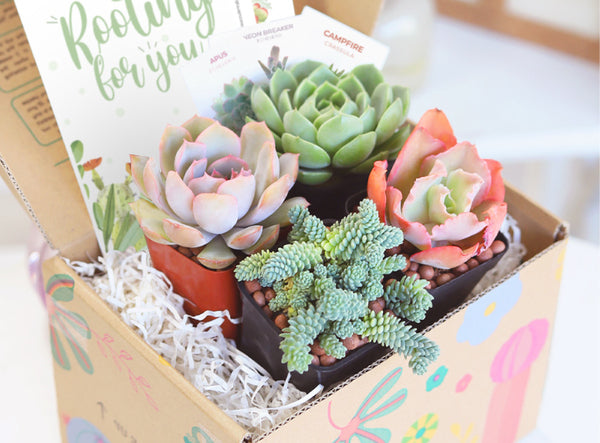
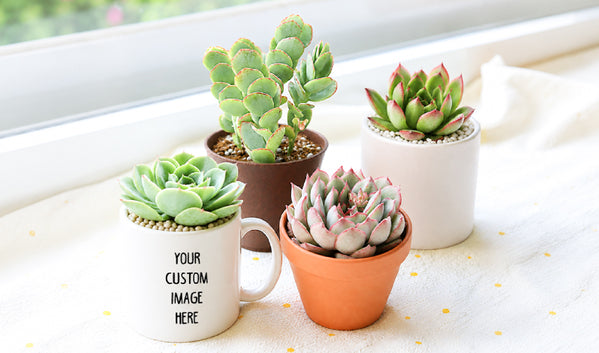



Our May box featuring Graptopetalum Superbum, Ruffle Jade Crassula, Crassula Springtime and Tiger Tooth Aloe Juvenna.
1. GRAPTOPETALUM SUPERBUM
 Graptopetalum Superbum has fleshy pale lavender leaves coated with a layer of white powder, which gives it a lovely pastel look.
 Mature plants can grow quite tall with stems that can be as long as 7 feet. The rosettes stay flat and compact, however.
 In late winter to early spring, it produces multiple branches of dainty star shaped flowers.
 Full Sun.
 Well-Drained.
2. RUFFLE JADE CRASSULA
Crassula arborescens subsp. undulatifolia is also known as Ripple Jade Crassula or Ruffle Jade Crassula. Minimum of 3 hours direct sunlight per day. Well-Drained, Porous, Gritty. Optimal pH is around 6.0 (slightly acidic). Average summer temperatures from 65ºF/18ºC to 70ºF/21ºC are ideal. In winter, it can survive temperatures as low as 50ºF/10ºC.
 Feed once with a controlled-release fertilizer at the beginning of the growing season.
 You can propagate Ruffle Jade Crassula by division, offsets or leaf cuttings. The easiest way is to propagate from a single leaf: put the leaf in a succulent or cacti mix, then cover until it sprouts.
3. CRASSULA SPRINGTIME
Crassula Springtime is a slow-growing succulent with thick green foliage.
Full Sun, Sun to Partial Shade, Light Shade. Water thoroughly when soil is dry to the touch, then let drain completely. Avoid letting water sit for too long in the soil to prevent rot and fungal diseases. Reduce watering in the winter. Porous and well-drained. Optimal pH is around 6.0 (slightly acidic). Average summer temperatures from 65ºF/18ºC to 70ºF/21ºC are ideal. In winter, it can survive temperatures as low as 50ºF/10ºC. Feed with a controlled-release fertilizer at the beginning of the growing season. You can propagate Crassula Springtime by division, offsets or leaf cuttings. The easiest way is to propagate from a single leaf: put the leaf in a succulent or cacti mix, then cover until it sprouts.
 Can be toxic to humans and animals
4. TIGER TOOTH ALOE JUVENNA
The plant sports bright green leaves which turn red or brown when received plenty of sunlight. These leaves have toothy margins (hence the name 'Tiger Tooth Aloe') and creamy white spots all over. As the plant grows, the leaves are stacked on top of each other creating a unique structure.
Full sun to Light shade. Porous and well-drained potting mix. Water thoroughly when soil is dry to the touch, then let drain completely. Reduce watering to a minimum in winter. Aloe Juvenna prefers warm temperatures from 70 to 80 °F (21 to 27 °C), but can survive temperatures as low as 40 °F (4.5 °C). Protect from frost. Feed with a cactus fertilizer in the summer only.


