


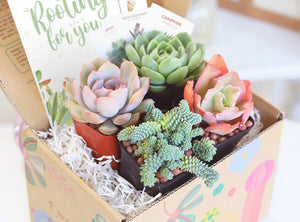
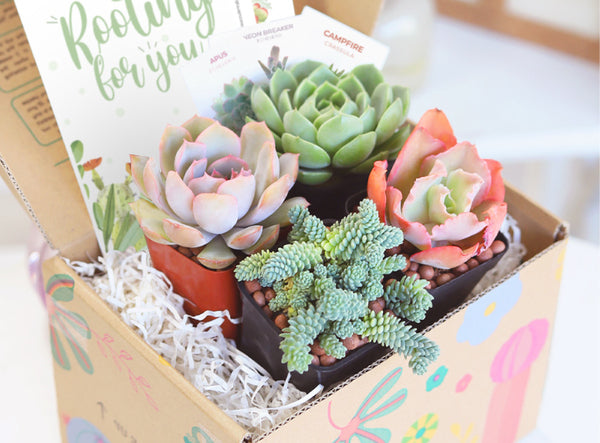
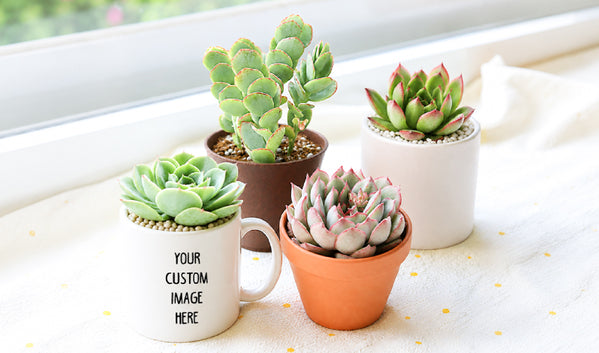


Our July box featuring Graptoveria Blue Pearl, Kalanchoe Sexangularis Lavender Scallop, and Peanut Cactus.
1. GRAPTOVERIA BLUE PEARL
 Graptoveria “Blue Pearl” has leaves of this beautiful color, to be exact, around the warm ruddy to blue hue.
  It has thinner leaves than other varieties and for this reason it may give the effect of blue starfish, especially when many plants grow together.
 If the color is not what you had expected or it changes, it may be due to lighting; try and change its position and see if it recovers its rare coloring in case.
 Full sun.
 Gritty, Porous and Well-Drained.
 Water thoroughly when soil is dry to the touch, then let drain completely. Avoid letting water sit for too long in the soil to prevent rot and fungal diseases. Reduce watering to a minimum in the winter.
 Feed once with a weak fertilizer at the beginning of the growing season (Spring or Summer).
2. KALANCHOE SEXANGULARIS
Kalanchoe Sexangularis is also commonly known as the ‘Six Angled Kalanchoe’. It is a hardy and drought-resistant succulent, with decorative red foliage that’s a must-have for the rockery, garden or patio, and unlike many other succulents, it will also flourish in dappled shade.
When grown in shade the leaves tend to be greenish red, more green than red, but when in full sun, they tend to be ruby red. The leaves also turn red when there is a drop in temperature during the winter months.
These succulents need strong light. When planting this succulent type in a garden, make sure it gets sunlight. Full to partial sun is the best for its growth. It is better to grow outdoor rather than indoor. The best way of watering is soak and dry method this succulent. Yet, the succulent should be controlled to avoid overwatering.
3. LAVENDER SCALLOPS KALANCHOE
Bryophyllum fedtschenkoi is a small succulent that grows shrubs of up to 2 feet (60 cm) tall. Its stems spread out and root along the ground to form large colonies with fleshy gray-green leaves with a cream color along the scalloped leaf margins. These thick leaves also have lavender-tinged edges. In late spring to early summer, bell-shaped reddish-brown flowers bloom in loose clusters from upright stems.
Full Sun. Porous and Well-Drained potting soil. Water thoroughly only when soil is dry to the touch, then let drain completely.
4. PEANUT CACTUS ECHINOPSIS
 Echinopsis chamaecereus is a branched cactus with crowded stems that resemble the shape of the fingers, up to 6 inches (10 cm) tall. It has pale green stems, up to 6 inches (15 cm) long and up to 0.5 inches (1.2 cm) in diameter. It has 8 to 10 ribs which have 10 to 15 soft and white bristles. Most people don't know that cactus can have orange & red blooms which are about 2 inches (5 cm) in diameter. Sometimes, they have a long branch and two smaller balls, therefore, we nickname it the "penis cactus".
Full sun. but might need partial shade in hot, dry summer. Porous and well-draining potting mix. Water deeply only when soil is dry and let it drain completely. Reduce watering during winter. Feed once a year during growing season.


