


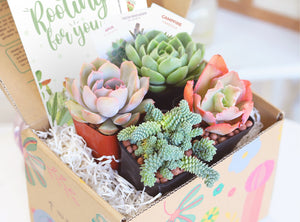
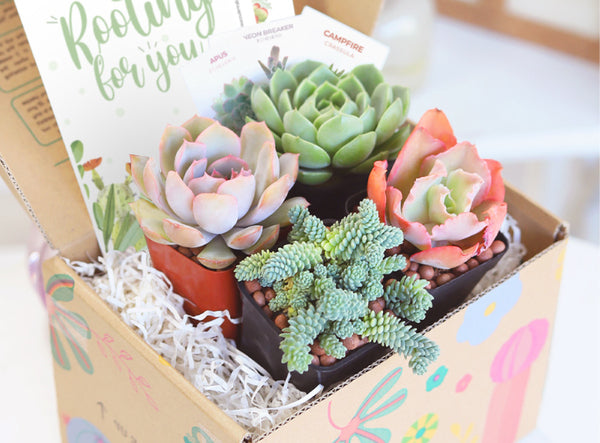


We introduce our December Succulents Subscription Box featuring all rare and hard-to-find succulents: Echeveria Perle Von Nunberg, Echeveria Raindrops, Agavoides Lipstick, Echeveria Dusty Rose.
Read on to find out about this month plants and their care guide.
1. Perle von Nunberg
 This succulent is a beautifully colored Echeveria Perle Von Nurnberg. The plant is a hybrid of E. Gibbiflora v. Metallica and E. Potosina.
 These plants are excellent for windowsill culture or as color accents in rock gardens or dish gardens. These make super colorful favors. Create your own container garden or centerpiece using the very popular succulents or buy in bulk to use these as wedding or party favors.
 Orange. Summer into Fall.
 Full Sun, Partial Sun, bright light with ample airflow.
 Porous soil with adequate drainage.
 Water thoroughly when soil is dry to the touch. Avoid letting water sit for too long in the rosette to prevent rot and fungal diseases.
 Protect from frost.
 Dead leaves should be removed from the plant as soon as possible to ward off pests.
 Generally non-toxic to humans and animals
2. Echeveria Raindrop
Echeveria Raindrops is an unusual succulent that has little globular bumps near the tips of its light green leaves. The bumps and tips of the leaves can turn pink or red in cold weather and bright light. Echeveria Raindrops can grow up to 6" wide.
Full or Partial Sun. A well-drained succulent mix. Avoid letting water sit for too long in the rosette to prevent rot and fungal diseases. . Dead leaves should be removed from the plant as soon as possible to ward off pests.
3. Echeveria Agavoides Lipstick
Echeveria Agavoides is an evergreen succulent native to Mexico. It has thick, triangular leaves that are similar to those of agaves, which gives it the name "Agavoides" - "looking like an agave". It has red tips with lots of sunlight exposure. Echeveria Agavoides is often solid, but healthy mature plants can produce offsets. In Spring or late Summer, it grows pink to red bell-shaped flowers with yellow tips. It is also called a lipstick plant.
Average, Well-Drained, Gritty. Needs occasional water in the summer. Sun, Mostly Sun. Red, Green. By stem or leaf cuttings in spring/early summer. Generally non-toxic to humans and animals.
4. Echeveria Dusty Rose
Echeveria Dusty Rose is an attractive succulent that forms fast growing rosettes of powdery violet leaves. The beautiful color on these succulents only gets better with more sunlight. It offsets freely to form clusters up to 8 inches (20cm) in diameter. The flowers are orange in color.
 Full sun. Perfect for a sunny window.
 Only needs occasional water.
 A well-drained succulent mix, with an ideal pH around 6.0.
 Feed with a controlled-release fertilizer at the beginning of the season. Generally non-toxic to humans and animals.
Want to learn more about
HOW AND WHEN YOU SHOULD BOTTOM WATER YOUR SUCCULENTS?
If you found this article interesting, share it with your succulent loving friends!
And get a free plant when your friends make an order. Sign up here!
Learn more about how to nurture and enjoy many gorgeous succulents and clever decoration tips with our newsletter. Let's sign up!
Recommended Items


