





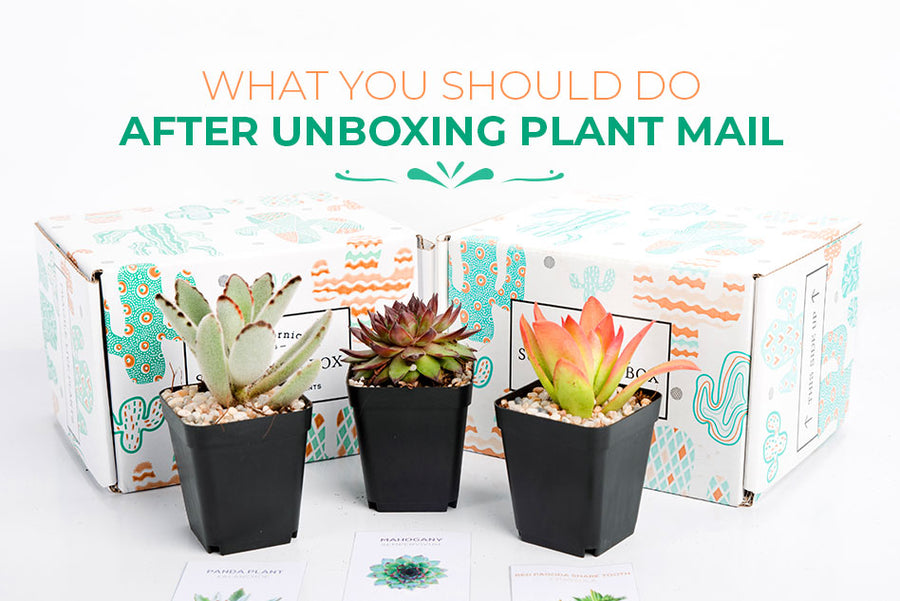
Treating plant mails that are stressed from shipping is very important. Though known as some of the most low-maintenance plants, succulents can have difficulty enduring a long transit and arrive in bad shape. Hence, giving them proper care to help them recover from the transit shock is necessary. So what you should to after receiving your succulents?
The first thing you should do is unboxing your succulents as soon as possible. Your succulents are kept in the narrow space without sunlight for a long time so let them enjoy some fresh air is the first step to help them recover. Place your plants in airy areas with some filtered sunlight. Avoid direct sunlight.

The next step is to examine the conditions of your succulent plants. Here are some different scenarios that might help you
Scenario 1: When your succulents arrive with dry and bare root

In this case, you can go ahead and plant it up in a porous pot and well-drained soil. Be careful not to damage their roots since they’re in a pretty fragile state. Once you finish repotting, put your succulents in indirect sunlight and leave them alone for about 2-3 days before watering. Once you water, give them a good soak till water drip out from the drainage hole.
Remember to acclimate your succulent slowly to the sun over the course of 2-3 weeks.

Scenario 2: When your succulent arrive potted in dry soil

If the soil in the pot is dry, you can just place your succulents in shade and leave them there for a good 2-3 days before watering them. Water them deeply so the roots can absorb sufficient water when the soil is completely dry out. Again, slowly introduce your succulent to the lighting condition in your home.
Scenario 3. When your succulents arrive with wet and bare root

The first thing you should do in this situation is putting the succulent in an airy place and let the roots air-dry for about 2-3 days. After that, you can re-pot your succulents in suitable pots with a good drainage hole.
Wait for the soil to drain out completely before watering your succulents. Remember to give them a good soak till water drip out from the drainage hole. Slowly introduce your succulent to lighting condition in your home.
Scenario 4. When your succulents arrive potted with wet soil

When your succulents arrive potted with wet soil, do a thorough check of their leaves and roots' condition.
If the succulents show any signs of being over watered like puffy and yellow bottom leaves, take the succulent out of the pot and carefully examine if there is any sign of root rot.
- If the roots and stem look fine, that indicates they might be slightly over watered. Try to remove wet soil from succulent roots and let it air dry for 2-3 days before re-potting it in a pot with good drainage and cactus soil. Wait at least 3 more days before watering. Please remember to check if the soil is completely dry before giving any more water.
- If you notice the roots and stem turning black, you should remove all black roots or even behead your succulents depending on how bad the plant condition is. Once you’re done removing all the rotten parts, let the cutting or the succulents air dry well for at least 3 days. Once they form a good callous, replant them in a pot with good drainage and free-draining soil. Wait another 2-4 days before watering them again.
If the succulent looks healthy and the leaves are firm and compact, you can leave it in the nursery pot and water only when the soil is completely dry. If preferred, re-pot the succulent in a suitable pot. Slowly introduce your succulent to lighting condition in your home.

For Types of Succulents Careguide. Read more information here.
And get a free plant when your friends make an order. Sign up here!
Learn more about how to nurture and enjoy many gorgeous succulents and clever decoration tips with our newsletter. Let's sign up!


