


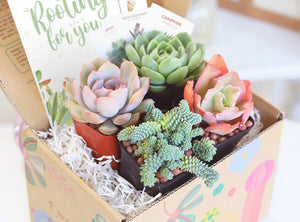
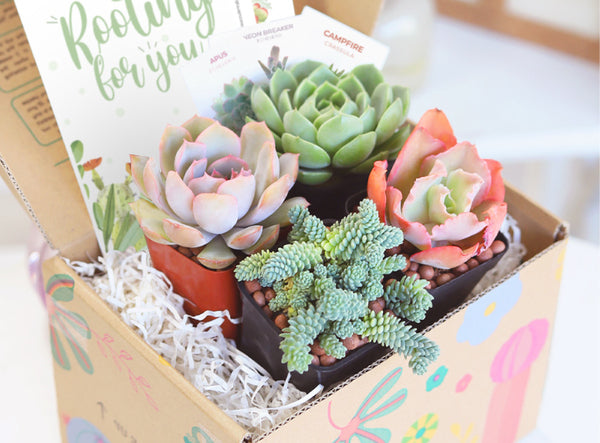


It's summer time and here's our cutie box for June featuring: Haworthia cymbiformis var. obtusa, Echeveria Melaco, Aloe Juvenna Tiger Tooth, Echeveria Blue Atoll.
Haworthia cymbiformis var. obtusa
 Haworthia cymbiformis var. obtusa is one of the innumerable morphological forms of the very variable Haworthia cymbiformis characterized by denser rosettes up to 6 inches (15 cm) in diameter, forming round clumps. It has peculiar bright green leaves that looks like molded glass. Thay are succulent, soft, very juicy, obovate with entire margins, and leaf-tips are rather obtuse or rounded.
 White to very pale pink flowers with brownish-green veins are borne on a 8 inches (20 cm) tall inflorescence.
 Light Shade.
  Use a cactus mix or very fast-draining potting soil mixed with sand.
 Average Water Needs, Water regularly, do not overwater.
USDA Zone: from 10a: to -1.1 °C (30 °F) to 11: above 4.5 °C (40 °F)
Echeveria Melaco
 Echeveria Melaco is an attractive succulent plant up to 6 inches (15 cm) tall, with shiny, up to 6 inches (15 cm) in diameter, brownish-red rosette with green center. The flowers are bell-shaped and orange in color.
Well-Drained, Gritty. Full Sun to Partial Shade. Avoid letting water sit for too long in the rosette to prevent rot and fungal diseases. Generally non-toxic to humans and animals.
 Needs excellent drainage in pots.
USDA hardiness zone 9b to 11b: from 25 °F (−3.9 °C) to 50 °F (+10 °C).
Aloe Juvenna Tiger Tooth
Aloe Juvenna, or Tiger Tooth Aloe, is a small succulent native to Kenya that grows upright stem up to 12 inches (30 cm) tall and starts branching from the base of the stem. The plant sports bright green leaves which turn red or brown when received plenty of sunlight. These leaves have toothy margins (hence the name 'Tiger Tooth Aloe') and creamy white spots all over. As the plant grows, the leaves are stacked on top of each other creating a unique structure. It produces salmon pink or orange red flowers with green tips from an inflorescence of up to 10 inches (25 cm).
Full sun to Light shade. Porous and well-drained potting mix. Water thoroughly when soil is dry to the touch, then let drain completely. Reduce watering to a minimum in winter.  Aloe Juvenna prefers warm temperatures from 70 to 80 °F (21 to 27 °C), but can survive temperatures as low as 40 °F (4.5 °C). Protect from frost.
  Feed with a cactus fertilizer in the summer only.
USDA Hardiness Zone 9a to 11b: from 20 °F (−6.7 °C) to 50 °F (10 °C).
Echeveria Blue Atoll
Echeveria 'Blue Atoll' is an evergreen succulent forming a very pretty rosette packed with fleshy, blue-green leaves. In spring, it sends up 8 inch tall (20 cm) stems which bear small orange and yellow flowers.
 Full sun. Partial sun.
  Only needs occasional water.
  A well-drained succulent mix.
  Feed with a controlled-release fertilizer at the beginning of the season.
 Generally non-toxic to humans and animals
USDA Zone 9b: to -3.8 °C (25 °F)
USDA Zone 10a: to -1.1 °C (30 °F)
USDA Zone 10b: to 1.7 °C (35 °F)
USDA Zone 11: above 4.5 °C (40 °F)
For Types of Succulents Careguide. Read more information here.
And get a free plant when your friends make an order. Sign up here!
Learn more about how to nurture and enjoy many gorgeous succulents and clever decoration tips with our newsletter. Let's sign up!
Recommended Items


