


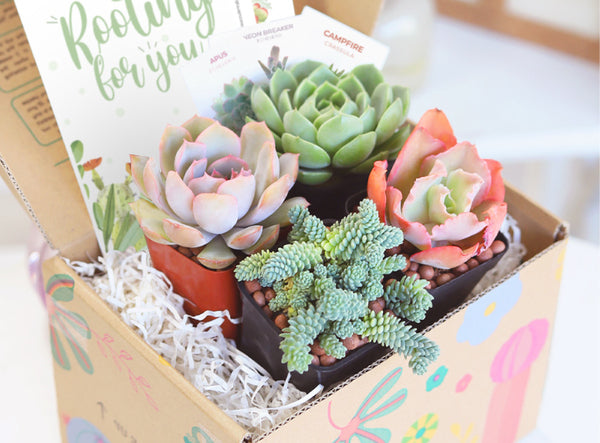


June box update alert 🌿This month we're featuring some of the most gorgeous indoor beauties: Haworthia Zebra, Echeveria Minima Blue, Echeveria Lola and Echeveria Blue Fairy. Follow our guide to learn about their specific needs for water, light, and soil.
Echeveria Minima Blue

 Echeveria Minima is native to Mexico. It is a cute miniature Echeveria that freely produces offets, forming tight clumps of lovely little rosettes. Echeveria Minima has short chubby silvery blue leaves tipped with pink or deep purple.
 In late spring, it produces orange bell shaped flowers.
 All of the plants will be shipped bare root.
 Full Sun.
 Cactus potting mix.
 Feed every 2 weeks
 Avoid letting water sit for too long in the rosette to prevent rot and fungal diseases.
 Dead leaves should be removed from the plant as soon as possible to ward off pests.
Echeveria Lola

Echeveria Lola is a popular Echeveria species that forms beautiful pale gray green rosettes of powdery pointed symmetrical leaves. The mature tight rosette resembles the look of a rosebud, which is a perfect choice for a gift. Echeveria Lola is a hybrid between Echeveria Lilacina & Echeveria Derenbergii, two also widely popular Echeveria Species. In spring, it produces coral bell-shaped flowers with pink yellow tips. All of the plants will be shipped bare root.
well draining soil. bright but indirect sunlight. Avoid letting water sit for too long in the rosette to prevent rot and fungal diseases. Dead leaves should be removed from the plant as soon as possible to ward off pests. Generally non-toxic to humans and animals
Haworthia Zebra

Haworthia Fasciata 'Zebra Haworthia" is one of the most popular Haworthia species. Its leaves are thin, and dark green with horizontal white ridges that resemble zebra striping. Zebra Haworthia is often grown as indoor plant because of its attractive appearance and low maintenance. It produces offsets freely, and the offsets can be propagated easily. All of the plants will be shipped bare root.
Bright light, but not direct sunlight.
Use a cactus mix or very fast-draining potting soil mixed with sand. the Zebra Plant flowers are small tubular white or pink flowers growing from a very thin kind of stem. It rarely blooms though and the flowers only last for a few days. Water only when soil feels dry to the touch and then drain completely. Never let the plant sit in water.
Echeveria Blue Fairy

The lovely Echeveria Blue Fairy is one of best selling succulents, and with good reason. This rosette has blue green foliage, and sometimes the pointed tips have a reddish color. Loves bright light, produces offsets randomly for new plants, and has these wonderful blooms with colorful flowers. The blooms can get up to 8 inches long. All of the plants will be shipped bare root. Make sure the soil is moist at all times during the spring and summer months. Water when soil is dry to the touch, which is approximately every 7 - 10 days. Avoid water it daily. Water them more in spring and summer and less in winter, and it’s better to underwater them than overwater them. Feed once with a weak fertilizer at the beginning of the growing season (Spring or Summer). You can propagate Echeveria 'Blue Fairy' by seeds, leaf cuttings or offsets.
For Types of Succulents Careguide, read more information here.
And get a free plant when your friends make an order. Sign up here!
Learn more about how to nurture and enjoy many gorgeous succulents and clever decoration tips with our newsletter. Let's sign up!


