


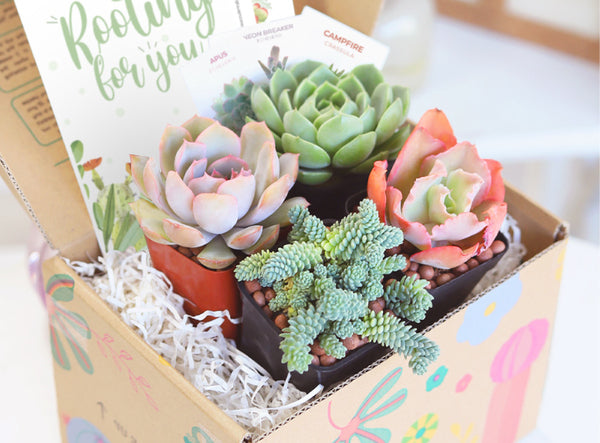


Our September box featuring Haworthia Cymbiformis Var. Obtusa, Trailing Jade Senecio Jacobsenii, Senecio Blue Chalk Sticks, Echeveria Setosa var. Deminuta & Tillandsia Schiedeana
1. Haworthia Cymbiformis Var. Obtusa
 Haworthia Cymbiformis Var. Obtusa is one of the innumerable morphological forms of the very variable Haworthia cymbiformis characterized by denser rosettes up to 6 inches (15 cm) in diameter, forming round clumps. It has peculiar bright green leaves that looks like molded glass. Thay are succulent, soft, very juicy, obovate with entire margins, and leaf-tips are rather obtuse or rounded.
 White to very pale pink flowers with brownish-green veins are borne on a 8 inches (20 cm) tall inflorescence.
2. Trailing Jade Senecio Jacobsenii
 Senecio Jacobsenii, or Trailing/Vining/Weeping Jade, is a creeping, easy-care succulent species native to Kenya and Tanzania. Once belonging to Senecio genus, Jacobsenii is now reclassified and put into the Kleinia family. Jacobsenii means Niels Jacobsen- the name of a Danish professor specializing in succulents.
 Trailing Jade Senecio Jacobsenii is often confused with Crassula Jade, but they are two different species. They both have flat, teardrop-shaped leaves densely packed around thick succulent stems, but Crassula Jade (or Crassula ovata) does not have trailing vines. Senecio Jacobsenii has lush green leaves that turn into vibrant magenta and bordeaux color when sun stressed. This plant can trail up to 4 feet in length. During the growing season in Spring-Summer, Senecio Jacobsenii blooms orange flowers with a cheesy smell.
3. Senecio Blue Chalks Sticks
Senecio Blue Chalksticks, also known as Senecio serpens or Senecio mandraliscae, is an attractive succulent with powdery blue-green fleshy leaves. The tips of these leaves turn purple in extreme heat and sun exposure. Blue Chalksticks is a slow-growing ground cover that branches from the base. It has very small white flowers in the summer. The plant grows up quickly with regular watering but it can also be drought tolerant. Suitable for container planting and hanging basket.
4. Echeveria Setosa var. Deminuta
Echeveria Setosa Var. Deminuta is an attractive species of Echeveria that is covered with soft harmless white hair. The rosette only grow up to 3 inches and has tiny, blue green, club-shaped leaves. It produces multiple offsets which form a cute hairy cluster. In spring and early summer, each rosette produces branches of distinctive bright red and yellow flowers that give it a fun nickname: "Firecracker Plant".
5. Tillandsia Schiedeana
Tillandsia Schiedeana is a species in the genus Tillandsia. Tillandsia schiedeana is native to Mexico, Central America. It has greenish-white, thin leaves and a pretty red and yellow flower.


