


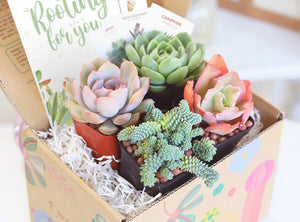
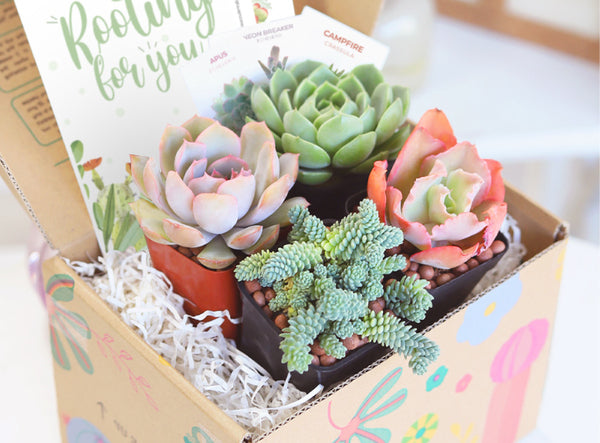


Our October box featuring Echeveria Perle Von Nurnberg, Echeveria Atlantis Succulent, Ice Plant Corpuscularia Lehmannii, Sedum Donkey's Tail Succulent and Tillandsia Capitata Peach
1. Echeveria Perle Von Nurnberg
 This succulent is a beautifully colored Echeveria Perle Von Nurnberg. The plant is a hybrid of E. Gibbiflora v. Metallica and E. Potosina.
 These plants are excellent for windowsill culture or as color accents in rock gardens or dish gardens. These make super colorful favors. Create your own container garden or centerpiece using the very popular succulents or buy in bulk to use these as wedding or party favors.
 Orange.
Summer into Fall.
 Full Sun, Partial Sun, bright light with ample airflow.
 Porous soil with adequate drainage.
 Water thoroughly when soil is dry to the touch. Avoid letting water sit for too long in the rosette to prevent rot and fungal diseases.
 Protect from frost.
 Dead leaves should be removed from the plant as soon as possible to ward off pests.
 Generally non-toxic to humans and animals
2. Echeveria Atlantis Succulent
Echeveria ‘Atlantis’ is an attractive succulent with round big rosettes. In the summer expect the rosettes to take on a powdery blue skin, but in colder temperatures this plant reaches her full potential with rich, red tips that are in striking contrast to the blueish-green bodies of the rosettes.
Full Sun.
Well-drained, porous.
Avoid letting water sit for too long in the rosette to prevent rot and fungal diseases.
Dead leaves should be removed from the plant as soon as possible to ward off pests.
3. Ice Plant Corpuscularia Lehmannii
 Corpuscularia lehmannii, commonly known as Ice Plant, is a succulent plant that can reach up to 8 inches (20 cm) tall and up to 12 inches (30 cm) wide.
Its leaves, which grow in opposing pairs, are dark green and as thick as ice cubes. These leaves are three-angled and grow up to 1.6 inches (4 cm) long.
Ice Plant produces yellow daisy-like flowers of up to 1.6 inches (4 cm) in diameter.
Full Sun, Partial Sun.
Water thoroughly when soil is dry to the touch, then let drain completely. Avoid letting water sit for too long in the soil to prevent rot and fungal diseases. Reduce watering in the winter.
Well-Drained, Porous, Gritty.
Average summer temperatures from 65ºF/18ºC to 70ºF/21ºC are ideal. In winter, it can survive temperatures as low as 50ºF/10ºC.
 You can propagate Ice Plant by division, cuttings or seeds. If propagating by division, dividing the plants in the spring is optimal. Cuttings can be taken anytime in the spring, summer or fall. When grown by seeds, scatter the seeds on top of the soil and do not cover them, allowing light to stimulate germination.
4. Sedum Donkey's Tail Succulent
Sedum Burrito/ Sedum Morganianum, also known as Burro's Tail or Donkey's Tail Succulent, is native to Mexico. It is an easy-to-grow perennial succulent and can tolerate any types of soil with good drainage. It has rounded and fleshy silver-green leaves that are densely packed on hanging stems.
 In spring, this plant may bloom clusters of pink to purple flowers, growing from the ends of the stems.
Soil, Sandy Soil, Loamy Soil, Drought/Dry Soil.
Full Sun.
Water deeply when soil is dry to the touch, then let drain completely.
Generally non-toxic to humans and animals.
5. Tillandsia Capitata Peach
Tillandsia Capitata Peach air plant is a delicate air plant, with wide, thick, sturdy leaves that are soft to the touch. It also has the prettiest silvery green leaves. Its shape is a somewhat symmetrical rosette. When it blooms the leaves blush beautiful shades of peach and pink.
Bright indirect sunlight.
No soil is needed. Sand, sea glass, rocks, pebbles & bark chip can be used instead of soil.
Frequent misting several times a week is necessary. Tillandsia Capitata Peach will also benefit from a soaking bath every week. Give it a little shake off afterwards to make sure water doesn't collect in the bottom leaves to prevent rot.


