


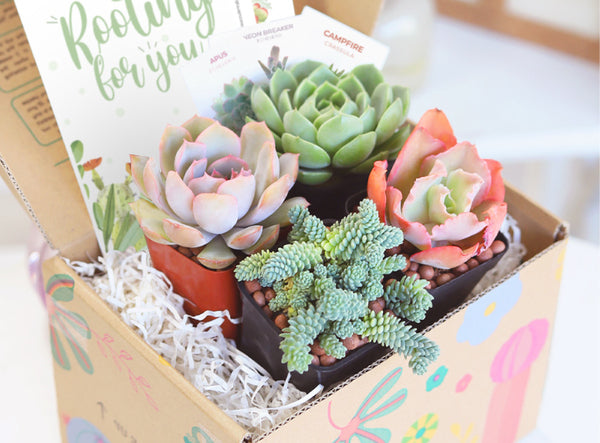
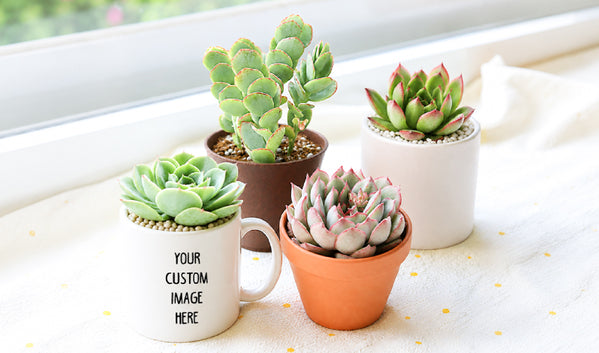


Our November box featuring Crassula Cotyledonis, Echeveria Lola, Haworthia Cymbiformis Var. Obtusa, and Sempervivum Green Wheel.
1. Crassula Cotyledonis
 Crassula cotyledonis is a low growing succulent native to South Africa that can reach up to 6 inches (15 cm) tall.
 Its grey green leaves are flat, rounded, paddle-shaped, grown in rosettes and covered with fine short hairs. The leaves have red or purple margins. The whole leaves can also turn vibrant red when stressed in cold temperatures.
 From spring to summer, Crassula cotyledonis produces clusters of small cream-yellow tubular flowers from each stem.
 Full Sun, Sun to Partial Shade, Light Shade.
 Average summer temperatures from 65ºF/18ºC to 70ºF/21ºC are ideal. In winter, it can survive temperatures as low as 50ºF/10ºC.
 You can propagate Crassula cotyledonis by division, offsets or leaf cuttings. The easiest way is to propagate from a single leaf: put the leaf in a succulent or cacti mix, then cover until it sprouts.
2. Echeveria Lola
Echeveria Lola is a popular Echeveria species that forms beautiful pale gray green rosettes of powdery pointed symmetrical leaves. The mature tight rosette resembles the look of a rosebud, which is a perfect choice for a gift. Echeveria Lola is a hybrid between Echeveria Lilacina & Echeveria Derenbergii, two also widely popular Echeveria Species. In spring, it produces coral bell-shaped flowers with pink yellow tips.
 well draining soil. Bright but indirect sunlight.
 Avoid letting water sit for too long in the rosette to prevent rot and fungal diseases.
 Dead leaves should be removed from the plant as soon as possible to ward off pests.
 Generally non-toxic to humans and animals
3. Haworthia Cymbiformis Var. Obtusa
Haworthia Cymbiformis Var. Obtusa is one of the innumerable morphological forms of the very variable Haworthia cymbiformis characterized by denser rosettes up to 6 inches (15 cm) in diameter, forming round clumps. It has peculiar bright green leaves that looks like molded glass. Thay are succulent, soft, very juicy, obovate with entire margins, and leaf-tips are rather obtuse or rounded. White to very pale pink flowers with brownish-green veins are borne on a 8 inches (20 cm) tall inflorescence.
Light Shade. Use a cactus mix or very fast-draining potting soil mixed with sand. Average Water Needs, Water regularly, do not overwater.
4. Sempervivum Green Wheel
Sempervivums, also known as Houseleeks or Hens and Chicks, are succulent perennials that form rosettes of succulent leaves that will often spread fast to form mats.
It produces some beautiful pink, or gold/yellow, blue and purple/lavender flowers around this time of year.
Keep your Sempervivums ‘Green Wheel’ in an environment where it can receive full sun.
It needs at least weekly watering, or more in extreme heat, preferably with regular water. Sempervivums do most of their growing in the spring and summer, and will thrive with weekly watering and afternoon shade if temperatures exceed 80F.
SEE MORE ABOUT THE BEST WATER FOR SUCCULENTS

For Types of Succulents Careguide. Read more information here.
And get a free plant when your friends make an order. Sign up here!
Learn more about how to nurture and enjoy many gorgeous succulents and clever decoration tips with our newsletter. Sign up now!


