


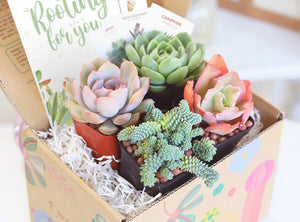
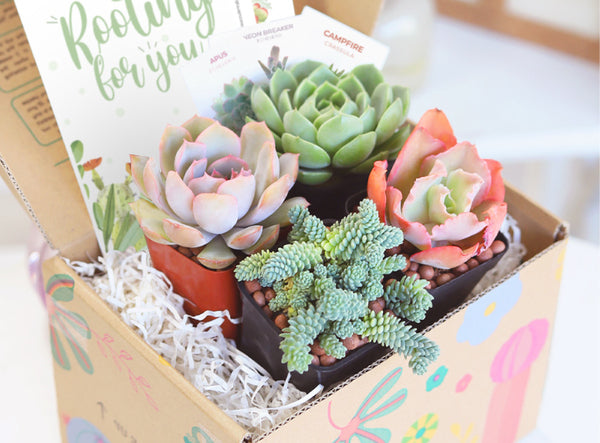
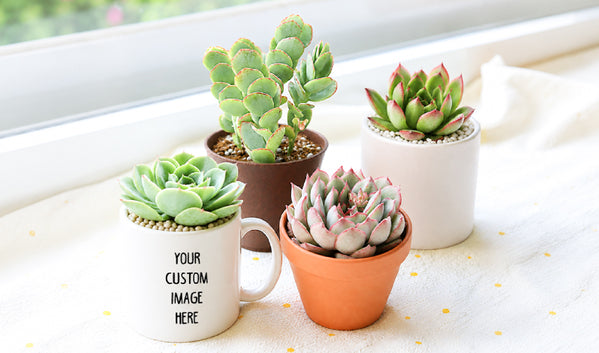


Our March box featuring Sempervivum Flamingo, Crassula Ruffle Jade, Kalanchoe Six Angled, and Haworthia Zebra.
1. Sempervivum Flamingo
 Sempervivum 'Flamingo' (Skrocki) is a stunning velvety rosette that changes color from delicate pink to deep purple as the seasons progress. This cultivar is a cross between S. 'Atroviolaceum' and S. 'Atroviolaceum', and it can have noticeable wax striations or "watermarks." The leaves of this rosette are tall and pointed, and it may become fairly large.
 Sempervivum Pink Flamingo is a perennial easy-to-grow succulent that is perfect in containers. It can live in very cold area therefore it is also a great plant for outdoor gardens.
 Gritty soil, Sandy.
 Full Sun or Partial shade.
 Water thoroughly when soil is dry to the touch, then let drain completely. Reduce watering to a minimum during winter.
 Feed with a controlled-release fertilizer at the beginning of the growing season.
 Sempervivum Pink Flamingo can easily be propagated by separating and replanting offsets in planting medium.
2. Crassula Ruffle Jade
Crassula arborescens subsp. undulatifolia is also known as Ripple Jade Crassula or Ruffle Jade Crassula (or sometimes as Lucky Plant or Money Tree). It is a succulent shrub that grows up to 3 feet (90 cm) tall and forms elliptic, blue-grey, twisted and erect leaves with purple margins. It produces very stout succulent branches and a natural bonsai-like aspect with compact rounded heads of white star-like flowers.
Minimum of 3 hours direct sunlight per day. Well-Drained, Porous, Gritty. Optimal pH is around 6.0 (slightly acidic). Average summer temperatures from 65ºF/18ºC to 70ºF/21ºC are ideal. In winter, it can survive temperatures as low as 50ºF/10ºC. Feed once with a controlled-release fertilizer at the beginning of the growing season. You can propagate Ruffle Jade Crassula by division, offsets or leaf cuttings. The easiest way is to propagate from a single leaf: put the leaf in a succulent or cacti mix, then cover until it sprouts.
3. Kalanchoe Six Angled
Kalanchoe Sexangularis is also commonly known as the ‘Six Angled Kalanchoe’. It is a hardy and drought-resistant succulent, with decorative red foliage that’s a must-have for the rockery, garden or patio, and unlike many other succulents, it will also flourish in dappled shade. When grown in shade the leaves tend to be greenish red, more green than red, but when in full sun, they tend to be ruby red. The leaves also turn red when there is a drop in temperature during the winter months.
These succulents need strong light. When planting this succulent type in a garden, make sure it gets sunlight. Full to partial sun is the best for its growth. It is better to grow outdoor rather than indoor. The best way of watering is soak and dry method this succulent. Yet, the succulent should be controlled to avoid overwatering.
4. Haworthia Zebra
Haworthia Fasciata 'Zebra Haworthia" is one of the most popular Haworthia species. Its leaves are thin, and dark green with horizontal white ridges that resemble zebra striping. Zebra Haworthia is often grown as an indoor plant because of its attractive appearance and low maintenance. It produces offsets freely, and the offsets can be propagated easily.
Bright light, but not direct sunlight. Use a cactus mix or very fast-draining potting soil mixed with sand. the Zebra Plant flowers are small tubular white or pink flowers growing from a very thin kind of stem. It rarely blooms though and the flowers only last for a few days. Water only when soil feels dry to the touch and then drain completely. Never let the plant sit in water.
See more about How to Grow and Care for Aeonium Plant

Click here to get all the details.
For Types of Succulents Careguide. Read more information here.
And get a free plant when your friends make an order. Sign up here!
Learn more about how to nurture and enjoy many gorgeous succulents and clever decoration tips with our newsletter. Let's sign up!
Recommended Items


