


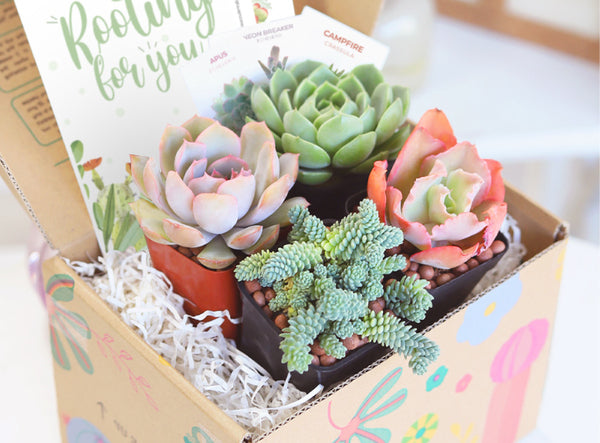


It's time for Spring. Our March box featuring Haworthia Zebra, Haworthia Cooperi, Senecio String of Bananas and Aeonium Green Platter
1. Haworthia Zebra

 Zebra Haworthia is often grown as indoor plant because of its attractive appearance and low maintenance. It produces offsets freely, and the offsets can be propagated easily.
 Bright light, but not direct sunlight.
 Use a cactus mix or very fast-draining potting soil mixed with sand.
 the Zebra Plant flowers are small tubular white or pink flowers growing from a very thin kind of stem. It rarely blooms though and the flowers only last for a few days.
 Water only when soil feels dry to the touch and then drain completely. Never let the plant sit in water.
2. Haworthia Cooperi

 Haworthia Cooperi is a slowly growing, low succulent plant. It grow in clumps of small rosettes of tiny, fleshy, light green leaves, up to 2 inches (5 cm) long. Its short stem produces many leaves that are just long enough to reach the soil surface, the transparent tips allowing light into the factory below.
Bright, indirect light, partial shade. Warm weather in the spring and fall are optimal for Window Haworthia. It can survive cool winter but will not do well under 40°F (4°C). Porous, well-drained potting mix with sand, pumice or decomposed granite. Water only when soil is dry to the touch. Let drain completely after each watering.
 Feed with an all-purpose fertilizer once at the beginning of the growing season, diluted to 50% of the recommended dose.
 Use offsets from the parent plant to grow new plants.
3. Senecio String of Bananas

 Senecio radicans String of Bananas is a fast-growing succulent with vines that can reach at least 3 feet (90 cm) long. The small, up to 1.2 inches (3 cm) long, green, pointed leaves grow single-file along the cascading stems, with the sides of the leaves partly translucent, allowing sunlight to shine through.
Light shade. Well-drained soil. Water thoroughly when soil is dry to the touch, then let drain completely. Avoid letting water sit for too long in the soil to prevent rot and fungal diseases. Reduce watering to a minimum in the winter. Can be toxic to humans and animals.
4. Aeonium Green Platter

 Aeonium Green Platters or Aeonium Pseudotabuliforme is a succulent plant with flat rosettes up to 6-10 inches wide of rounded and shiny green leaves, easy to care. It blooms yellow flowers in spring on a pyramidal inflorescence though quite infrequently. It is perfect as a groundcover or in containers.
 Full sun, Partial sun, Partial shade.
 Porous and well-drained potting mix.
 This plant only needs a low to moderate amount of water. Water thoroughly only when soil is dry to the touch, then let drain completely.
 You can easily propagate Aeonium Green Platters by stem cuttings.
READ MORE ABOUT
6 BLUE SUCCULENTS THAT YOU NEED IN YOUR GARDEN

If you found this article interesting, share it with your succulent loving friends!
And get a free plant when your friends make an order. Sign up here!
Learn more about how to nurture and enjoy many gorgeous succulents and clever decoration tips with our newsletter. Let's sign up!


