


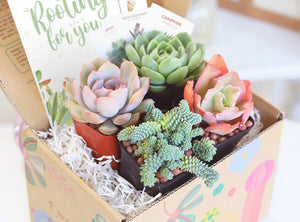
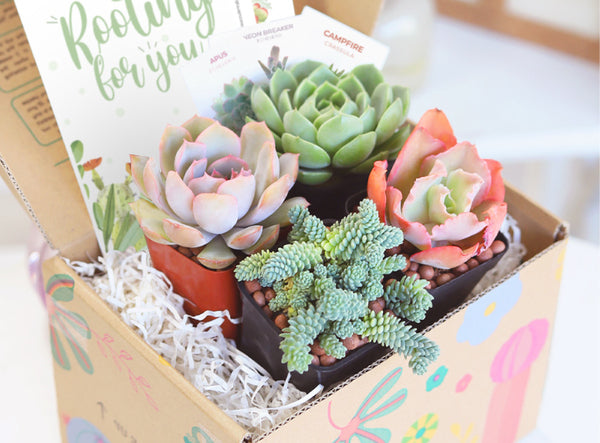
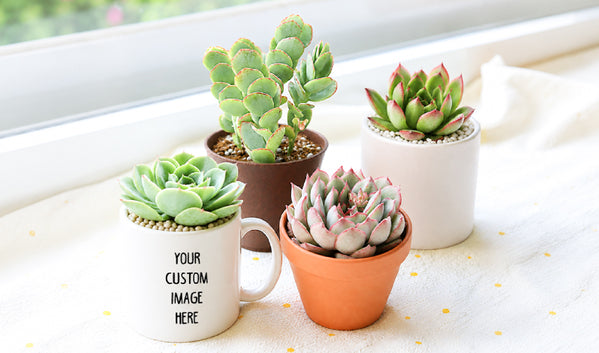


Our July box featuring Sempervivum Red Lion, Haworthia Cuspidata, Echeveria Perle Von Nurnberg, and Adromischus fillicaulis ssp. marlothii.
1. Sempervivum Red Lion
 Sempervivum Red Lion is also called "Hen and Chicks Red Lion" Succulent. The rosettes are vibrant rich red with green tips and sometimes have yellow variegated color as well.
 Sempervivum Red Lion is a perennial easy-to-grow succulent that is perfect in containers. It can live in very cold area therefore it is also a great plant for outdoor gardens.
 Gritty soil, Sandy.
 Full Sun or Partial shade.
 Water thoroughly when soil is dry to the touch, then let drain completely. Reduce watering to a minimum during winter.
 Feed with a controlled-release fertilizer at the beginning of the growing season.
 Sempervivum Red Lion can easily be propagated by separating and replanting offsets in planting medium.
2. Haworthia Cuspidata
Haworthia cuspidata is a strong and pretty hardy succulents. It forms star-like shaped rosette up to 4 inches in diameter. Also called "Star Window Plant", it has dark green leaves with translucent areas near the tips. It grows offsets freely and hence can be grown as a ground cover. In spring, it produces small white flowers on thin long stems
Bright light, but not direct sunlight. Use a cactus mix or very fast-draining potting soil mixed with sand. Water only when soil feels dry to the touch and then drain completely. Never let the plant sit in water.
3. Echeveria Perle Von Nurnberg
This succulent is a beautifully colored Echeveria Perle Von Nurnberg. The plant is a hybrid of E. Gibbiflora v. Metallica and E. Potosina. These plants are excellent for windowsill culture or as color accents in rock gardens or dish gardens. These make super colorful favors. Create your own container garden or centerpiece using the very popular succulents or buy in bulk to use these as wedding or party favors. Full Sun, Partial Sun, bright light with ample airflow. Porous soil with adequate drainage. Water thoroughly when soil is dry to the touch. Avoid letting water sit for too long in the rosette to prevent rot and fungal diseases. Protect from frost.
 Dead leaves should be removed from the plant as soon as possible to ward off pests.
 Generally non-toxic to humans and animals
4. Adromischus fillicaulis ssp. marlothii
 Adromischus Filicaulis ssp. Marlothii is a flowering plant species of the Crassulaceae family. This succulent has bulbous leaves. The thick leaves is either round or teardrop shaped. It has a green base tone and can create dark red spots when exposed to sunlight. It grows in a creeping, trailing manner. Aerial roots grow along the stems and will root down if they come into contact with soil. Adromischus Filicaulis ssp. Marlothii is a slow growing succulent species and can reach approximately 8” tall.
The Adromischus Filicaulis ssp. Marlothii thrives well under full sun, bright indoor light. However, avoid direct sunlight to prevent evaporation. This succulent is a drought-tolerant. Water it moderately and only when the soil is completely dry. Well-drained, Porous soil. This plant thrives in temperatures of 50°F-70°F. It is vital to ensure the room temperature does not fall below 50°F. This plant should be fertilized once during the growing season (spring/summer) with diluted houseplant fertilizer.
For Types of Succulents Careguide. Read more information here.
And get a free plant when your friends make an order. Sign up here!
Learn more about how to nurture and enjoy many gorgeous succulents and clever decoration tips with our newsletter. Let's sign up!


