


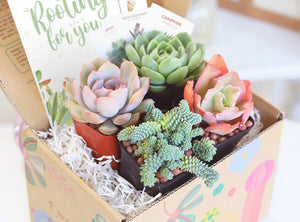
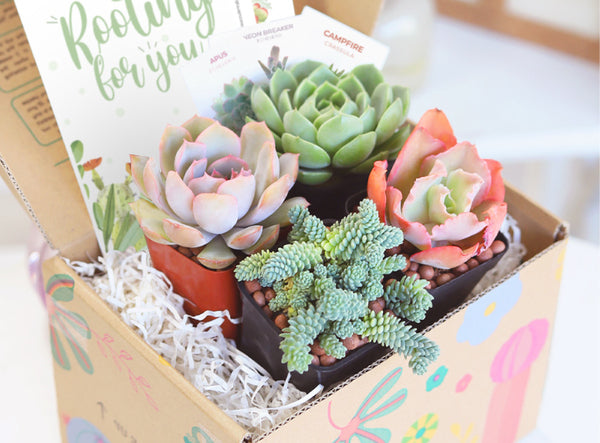


The first month of 2021 has gone by in a blink. Now we welcome February Box with these plant cuties: Golden Ball Cactus Echinocactus, Variegated String of Buttons, Anacampseros Telephiastrum, Crassula High Voltage Succulent and Tillandsia Funckiana air plant.
1. Golden Ball Cactus Echinocatucs

 Parodia leninghausii is also called Golden Ball, Lemon Ball, or Yellow Tower. It's covered with harmless thin yellow spines.
 Plenty of sunshine.
 Water deeply and let dry.
 Mixture used for cactus plants.
 Cool to cold.
USDA Zone 9a - 11.
2. Variegated String of Buttons

 Crassula perforata ‘Variegata’ is a variegated form of Crassula perforata. It grows and spreads out considerably fast into shrubs of up to 18 inches (46 cm) tall. The leaves are up to 1 inch (2.5 cm) long. Variegated leaves are gathered at the top of the plant and the lower leaves lose their variegation. It blooms with pale yellow flowers in spring.
Well-Drained soil Full Sun, Partial Sun Avoid letting water sit for too long in the soil to prevent rot and fungal diseases.
USDA Zone 9b - 11.
3. Anacampseros Telephiastrum

 Anacampseros Telephiastrum is a dense mat and caudex forming succulent up to inches (15 cm) tall, with lanceolate shaped green, bright pink and yellow or cream colored leaves.
 Anacampseros grow well in partial sun with bright light enhancing the leaf colors and keeping them compact.
 They require a gritty free-draining soil with added organic material and low to moderate watering. The beautiful caudiciform species are prone to rot and should be watered very sparingly.
 Feed with a high potassium fertilizer in summer during the growing season diluted to one-fourth potency and mix into the watering can for application. Anacampseros is an excellent plant for container growing. It always looks good and stays small. It look fine in a cold greenhouse and frame. It do well outdoors in raised beds and terraces as well.
Zone 8a - 9b.
4. Crassula High Voltage

Crassula Rupetris High Voltage is a branching succulent with triangular leaves that develop pink to red edges in bright sunlight. It has a branching habit and can get leggy. Cutting it back will allow the plant to grow fuller as two new branches will grow from every cut.
Full sun. Well-Drained, Porous, Gritty. Optimal pH is around 6.0 (slightly acidic). Water thoroughly when soil is dry to the touch, then let drain completely. Avoid letting water sit for too long in the soil to prevent rot and fungal diseases. Reduce watering in the winter. Feed once with a controlled-release fertilizer at the beginning of the growing season.
 You can propagate Crassula High Voltage by division, offsets or leaf cuttings. The easiest way is to propagate from a single leaf: put the leaf in a succulent or cacti mix, then cover until it sprouts.
5. Tillandsia Funckiana

Tillandsia Funckiana’s little species from Venezuela. It has long stems that twist and curve and are covered with thin, needle-like leaves. When in bloom, it will spike and flower and will produce a beautiful and vibrant orange-red coloring. Which is a rarer color for air plants.
Tillandsia funckiana requires good light and can enjoy full sun. Place the plant very close to a window indoors in the winter and preferably outside the summer in a bright or sunny situation. No soil is needed. Sand, sea glass, rocks, pebbles & bark chips can be used instead of soil. Two or three times a week in summer, one or two times a week in winter according to the luminosity and the ambient humidity.
USDA Zone: 9b - 11.
SEE MORE ABOUT HOW TO DIY A STUNNING SUCCULENT HEART FOR VALENTINE

If you found this article interesting, share it with your succulent loving friends!
And get a free plant when your friends make an order. Sign up here!
Learn more about how to nurture and enjoy many gorgeous succulents and clever decoration tips with our newsletter. Let's sign up!
Recommended Items


