


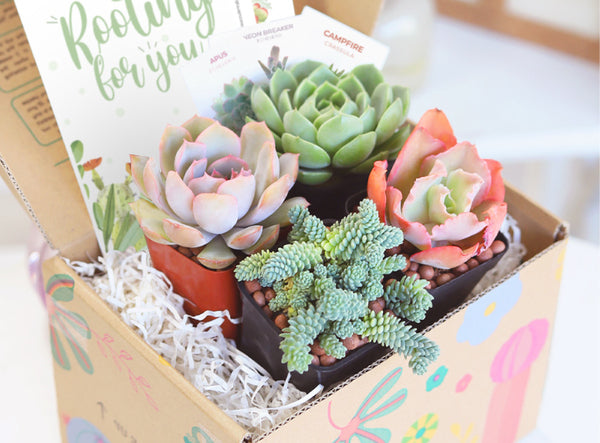



Our August box featuring Crassula Congesta Green Beans, Haworthia Pumila African Pearl, Sedum Fire Storm, Mini Rat's Tail Cactus & Tillandsia Bulbosa Belize
1. Crassula Congesta Green Beans
 Crassula Congesta Green Beans have adorable chubby oval leaves that are soft and velvety and look like little beans. It usually grows up to 4 inches ( 10 cm) in height but somatimes taller in shadier spots and always has only a single stem.The highly succulent leaves are up to 1,2 inches (3cm) long.
 This crassula blooms flowers with shades of rose/mauve, pale yellow or green in late spring to early summer.
 Full Sun, Sun to Partial Shade, Light Shade.
 Porous and well-drained. Optimal pH is around 6.0 (slightly acidic).
 Water thoroughly when soil is dry to the touch, then let drain completely.
2. Haworthia Pumila African Pearl
Haworthia Pumila African Pearl is one of the most striking Haworthia with narrow pointy leaves marked with bumpy, raised white spotty bands. The tightly packed leaves are arranged in a spiral pattern, forming columnar rosettes up to 8 inches tall. Haworthia Reinwardtii produces offsets freely to form a mat. In spring, the mature rosettes produce white flowers on thin, long stems.
Bright light, but not direct sunlight. Use a cactus mix or very fast-draining potting soil mixed with sand. Water deeply when soil is dry and let water drain out completely.
3. Sedum Fire Storm
Sedum Adolphii, also known as Golden Sedum or Sedum Firestorm, is a tender succulent that grows up to 8 inches (20 cm) tall. It is a groundcover that forms rosettes of green-yellow leaves, up to 1.4 inches (3.5 cm) long. Sedum Adolphii develops orange or red hue when it receives a great amount of sunlight. As the rosettes mature, they grow new leaves at the center and shed the older leaves on the soil. These old leaves can root and grow into new plants. Sedum Adolphii produces small cream-colored flower heads in spring.
Clay Soil, Sandy Soil, Loamy Soil, Drought/Dry Soil. Water deeply when soil is dry to the touch, then let drain completely. Full Sun.
4. Mini Rat's Tail Cactus
Aporocactus Flagelliformis - Mini Rat's Tail Cactus, native to Mexico, is a unique succulent. It is distinctive for its long, trailing stems, fine spines that grow to 6 feet in length at maturity. The overall color of the plant is green when young but the stems age to almost beige color. Pink, crimson to red, abundant, fragrant, and attractive to hummingbirds and pollinators. All of the plants may be shipped bare root.
Full sun to partial shade. Water generously during the active growth period and very sparingly during the rest period. Porous and well-drained cactus mix.
5. Tillandsia Bulbosa Belize
 Tillandsia Bulbosa Belize is an air plant with long twisting curly leaves grown from a large bulbous base. The leaves can turn from green to bright red when the Bulbosa is about to bloom beautiful tubular bright purple flowers.
 Bright filtered light.
 Frequent misting several times a week is necessary, especially during its growing season in the summer. Bulbosa will also benefit from a soaking bath every month. Give it a little shake off afterwards to make sure water doesn't collect in the bottom leaves to prevent rot.


