


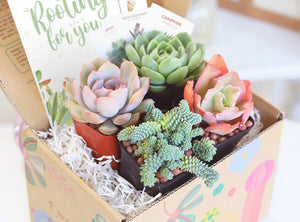
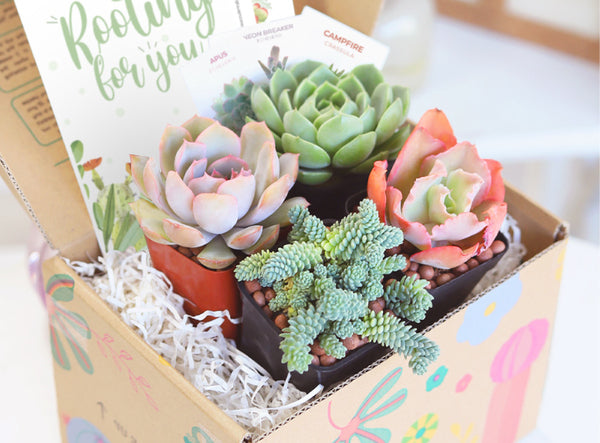



Are you ready for our amazing July box? Featuring : Sedum Fire Storm, Echeveria Sedeveria Blue Elf, Green Jelly Bean Sedum, Sempervivum Calcareum.
SEDUM FIRE STORM
 Sedum Adolphii, also known as Golden Sedum, is a tender succulent that grows up to 8 inches (20 cm) tall. It is a groundcover that forms rosettes of green-yellow leaves, up to 1.4 inches (3.5 cm) long.
 Sedum Adolphii develops orange or red hue when it receives a great amount of sunlight. As the rosettes mature, they grow new leaves at the center and shed the older leaves on the soil. These old leaves can root and grow into new plants.
 Sedum Adolphii produces small cream-colored flower heads in spring.
 Clay Soil, Sandy Soil, Loamy Soil, Drought/Dry Soil.
 Water deeply when soil is dry to the touch, then let drain completely.
 Full Sun.
ECHEVERIA SEDEVERIA BLUE ELF
Echeveria Blue Elf is a hybrid between Sedum and Echeveria, which gives it the rosette look of Echeveria and the ability to grow multiple offsets of Sedum. Sedeveria Blue Elf has teal green leaves with amazing red tips that darken in winter.
An outstanding bloomer, Sedeveria Blue Elf produces clusters of bright yellow flowers multiple times a year, which give it its nickname "Happy Plant".
 All of the plants will be shipped bare root.
Full Sun.
Porous Soil.
Avoid letting water sit for too long in the rosette to prevent rot and fungal diseases.
 Dead leaves should be removed from the plant as soon as possible to ward off pests.
GREEN JELLY BEAN SEDUM
Sedum Pachyphyllum, also known as Green Jelly Bean Sedum, is a cute succulent with short chubby silvery green leaves that have red tips when grown in full sun.
It has a shrubbing habit and can grow bushes up to 1 foot tall. It may become leggy with age. The leaves and stems can be easily propagated.
In summer, it produces clusters of bright yellow flowers.
Full Sun.
Water deeply when soil is dry to the touch, then let drain completely.
Soil that is well aerated is best suited.
SEMPERVIVUM CALCAREUM
It is a succulent perennial plant that can reach 6 inches (15 cm) tall.
Its rosettes are beautifully symmetrical with a dome shape. The leaves are blue-green and have pointy burgundy tips.
 Sempervivum calcareum forms dense mats by multiplying via short-stalked offsets.
In summer, some mature rosettes produce clusters of starry, yellow-eyed, light pink flowers on thick stalks.
The rosettes that flower will naturally die afterwards, but by this time, the plant has likely produced many offsets that will continue to grow.
All of the plants will be shipped bare root.
Gritty soil, Sandy.
Full Sun or Partial shade.
Water thoroughly when soil is dry to the touch, then let drain completely. Reduce watering to a minimum during winter.
 Temperature: Prefers warm summer temperatures (65ºF/18ºC – 70ºF/21ºC). In winter, it can tolerate temperatures down to freezing.
For Types of Succulents Careguide. Read more information here.
And get a free plant when your friends make an order. Sign up here!
Learn more about how to nurture and enjoy many gorgeous succulents and clever decoration tips with our newsletter. Let's sign up!
Recommended Items


