


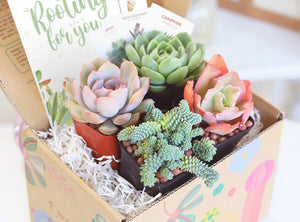
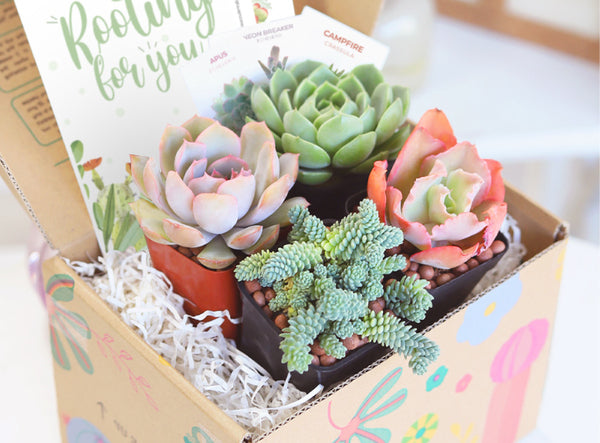


Our September box featuring Echeveria ‘Atlantis’, Cotyledon Orbiculata Pig's Ear, Senecio Ruby Necklace, and Sempervivum Spring Beauty.
1. Echeveria 'Atlantis'
 Echeveria ‘Atlantis’ is an attractive succulent with round big rosettes. In the summer expect the rosettes to take on a powdery blue skin, but in colder temperatures this plant reaches her full potential with rich, red tips that are in striking contrast to the blueish-green bodies of the rosettes.
 Full Sun.
 Well-drained, porous.
 Avoid letting water sit for too long in the rosette to prevent rot and fungal diseases.
 Dead leaves should be removed from the plant as soon as possible to ward off pests.
2. Cotyledon Orbiculata Pig's Ear
 Cotyledon Orbiculata (Pigs Ear) is able to reach around 60 cm (24″) tall. The plant is a hardy succulent with fleshy, oval, red-rimmed leaves that resemble a pig’s ear.
 The plant flowers it is known to produce red to orange flower that grow from the top of a long stem.
 It prefers a sunny location, but tolerates partial shade
 Water the plant when the soil is dry, then let the soil dry before watering again. In its natural environment, the plant needs very little water.
3. Senecio Ruby Necklace
Othonna capensis ‘Ruby Necklace’ is a trailing succulent with multiple purple pink stems and long narrow bean-shaped leaves. The beans have beautiful vibrant colors of green, purple, or deep red. The more light they receives, the more red they become. The delicate shape and red colors of these leaves are similar to precious gem pendants on necklaces, giving it the name 'Ruby Necklace'. The plant displays little yellow daisy like flowers on a long reddish stalk all year round. Full sun. Filtered sunlight. Partial shade in the summer. Porous and well-drained potting soil. Water thoroughly when soil is dry to the touch, then let drain completely. Avoid letting water sit for too long in the soil to prevent rot and fungal diseases. Reduce watering during their dormancy in the summer.
4. Sempervivum Spring Beauty
Sempervivum Spring Beauty (Hen and Chicks) is a hardy evergreen perennial succulent with light green leaves, producing masses of small offsets during the summer. Each plant grows for several years before flowering. The colour of the flowers is reddish, yellowish, pinkish, whitish. The plants need plenty of outdoor sunlight to show their best colors and maintain a tight rosette form. Water thoroughly when soil is dry to the touch, then let drain completely. Reduce watering to a minimum during winter.
Sooo what is the succulent that you love the most this month? Share them with us in the comment section below!
SEE MORE ABOUT DEMYSTIFY NATURAL LIGHT FOR SUCCULENTS

For Types of Succulents Careguide. Read more information here.
And get a free plant when your friends make an order. Sign up here!
Learn more about how to nurture and enjoy many gorgeous succulents and clever decoration tips with our newsletter. Sign up now!


