


Our October box featuring Echeveria Emerald Ripple, Crassula Campfire Plant, Tillandsia aeranthos hybrid, Echeveria 'Painted Frills', and Echeveria Elegans Mexican Snowball.
1. Echeveria Emerald Ripple
 Echeveria Emerald Ripple is a succulent in the Crassulaceae family, native to semi-arid regions of Mexico. It evolved to store water in its fleshy leaves and grow in bright, dry conditions.
 It forms a tight, upright rosette of thick, spoon-shaped leaves in emerald green with gently ruffled, rippled edges that give the cultivar its name. The leaf surfaces have a powdery farina coating that adds a soft, silvery sheen and helps it manage heat and light. This compact growth style reaches about 4 to 6 inches in diameter at maturity.
 Echeveria Emerald Ripple produces arching flower stalks with coral to pinkish-orange bell-shaped blooms, typically appearing in spring or early summer. Bloom frequency increases when the plant experiences a natural drop in nighttime temperatures, so moving it outdoors in autumn before bringing it back inside encourages flowering the following season.
 Rotate the pot regularly to keep the rosette growing evenly, and always provide cover from rain to prevent rot. It is pet friendly and non-toxic to cats and dogs. It transitions between indoors and outdoors during summer months. The plant is drought tolerant and comfortable in dry air and low humidity environments. It also makes an excellent outdoor plant for patios, rock gardens, and container arrangements in warm climates.
 Echeveria Emerald Ripple grows well in bright indirect light and may scorch in intense south-facing windows.
 Water it deeply every 10 to 14 days in summer, reducing to once monthly in winter.
Echeveria Emerald Ripple does best in a gritty, well-draining cactus and perlite mix at roughly 50/50.
 It prefers temperatures between 65 to 80°F and is frost-sensitive below 25°F.
 Echeveria Emerald Ripple is a slow to moderate grower; feed it monthly in spring and summer with diluted balanced fertilizer.
2. Crassula Campfire Plant
Crassula Campfire Plant is a drought-tolerant succulent from the Crassulaceae family, native to South Africa's rocky hillsides and dry scrublands. It has a following among collectors and beginners alike for its dramatic foliage color shifts and straightforward care needs.
The plant's signature trait is its propeller-like leaves stacked tightly in cascading rows along each stem, forming a clumping and trailing rosette that spills over pot edges. Foliage emerges lime green, then transforms into yellow, orange, and fiery red as sun exposure increases, with leaves smooth and slightly waxy throughout. Campfire's layered, flame-like silhouette comes from tightly overlapping leaves that sit perfectly flat against one another.
Small clusters of white to pale pink star-shaped flowers appear in late winter to spring when nighttime temperatures drop consistently. Cooler nights trigger flowering, so ensure it experiences that temperature dip to encourage blooms.
Position Campfire on a sunny windowsill indoors or move it to a bright patio in summer, bringing it inside before frost arrives and shielding it from heavy rain during outdoor stints. Its trailing growth makes it a natural choice for hanging planters or cascading over the edge of a dish garden. Keep it on a high shelf away from cats, dogs, and small children, as the sap causes skin or paw irritation. You can leave it up to ten days without water.
Crassula Campfire Plant grows well in bright direct sun, with a south- or east-facing window working well indoors and bringing out the most vivid reds and oranges.
Water it deeply every 10 to 14 days in summer, reducing to once every 3 to 4 weeks in winter when growth slows.
Campfire does best in a gritty, well-draining succulent or cactus mix blended with 30 to 50 percent perlite.
It prefers temperatures between 65 and 80°F and should be protected from frost below 32°F.
Campfire is a moderate grower that benefits from diluted balanced fertilizer applied once in spring and once in early summer.
3. Tillandsia aeranthos hybrid

Tillandsia aeranthos hybrid is a graceful air plant with slender green leaves and an airy, sculptural form. It is easy to care for and adapts well to a variety of indoor spaces. When in bloom, it can produce eye-catching pink to purple flowers that add a vibrant touch to its unique appearance.
 All of the plants may be shipped bare root.
Bright filtered light.
No soil is needed. Sand, sea glass, rocks, pebbles & bark chip can be used instead of soil.
Frequent misting several times a week is necessary. Tillandsia aeranthos hybrid will also benefit from a soaking bath every month. Give it a little shake off afterwards to make sure water doesn't collect in the bottom leaves to prevent rot.
4. Echeveria 'Painted Frills'

Echeveria ‘Painted Frills’ is a striking hybrid succulent known for its colorful rosette and delicately ruffled leaves. It is a cross between Echeveria shaviana ‘Pink Frills’ and Echeveria nodulosa, combining attractive color with an elegant, sculptural form
Its fleshy leaves form a broad rosette that can develop shades ranging from icy blue to rich red, with soft pink margins and gently ruffled edges. Mature rosettes can reach around 7-8 inches across while remaining relatively low-growing.
Painted Frills regularly produces offsets around the base, allowing it to gradually form an attractive cluster of rosettes. It can also produce orange flowers, adding another pop of color above the foliage.
 This compact succulent works beautifully on sunny windowsills, shelves, succulent arrangements, and outdoor containers in warm weather. Its offsets can be separated and replanted, and like many Echeverias, it can also be propagated from mature leaves or stem cuttings. Painted Frills is also listed as pet safe.
Echeveria ‘Painted Frills’ grows best in bright indoor light or filtered to partial sun. Plenty of light helps maintain its compact rosette shape and vibrant coloration.
Painted Frills needs fast-draining cactus and succulent soil. A mix containing about 50-70% mineral grit, such as pumice, perlite, or coarse sand, helps prevent excess moisture around the roots.
Water thoroughly until excess water drains from the pot, then allow the soil to dry completely before watering again. Avoid keeping the soil constantly moist, as Echeverias are sensitive to rot.
Painted Frills does not need heavy feeding. During active growth, a diluted balanced liquid fertilizer can be applied occasionally, while feeding should be reduced or stopped during winter.
Painted Frills is not frost hardy and should be protected from freezing temperatures. For indoor growing, keep it above about 50°F (10°C) and move outdoor plants inside before frost arrives.
5. Echeveria Elegans Mexican Snowball
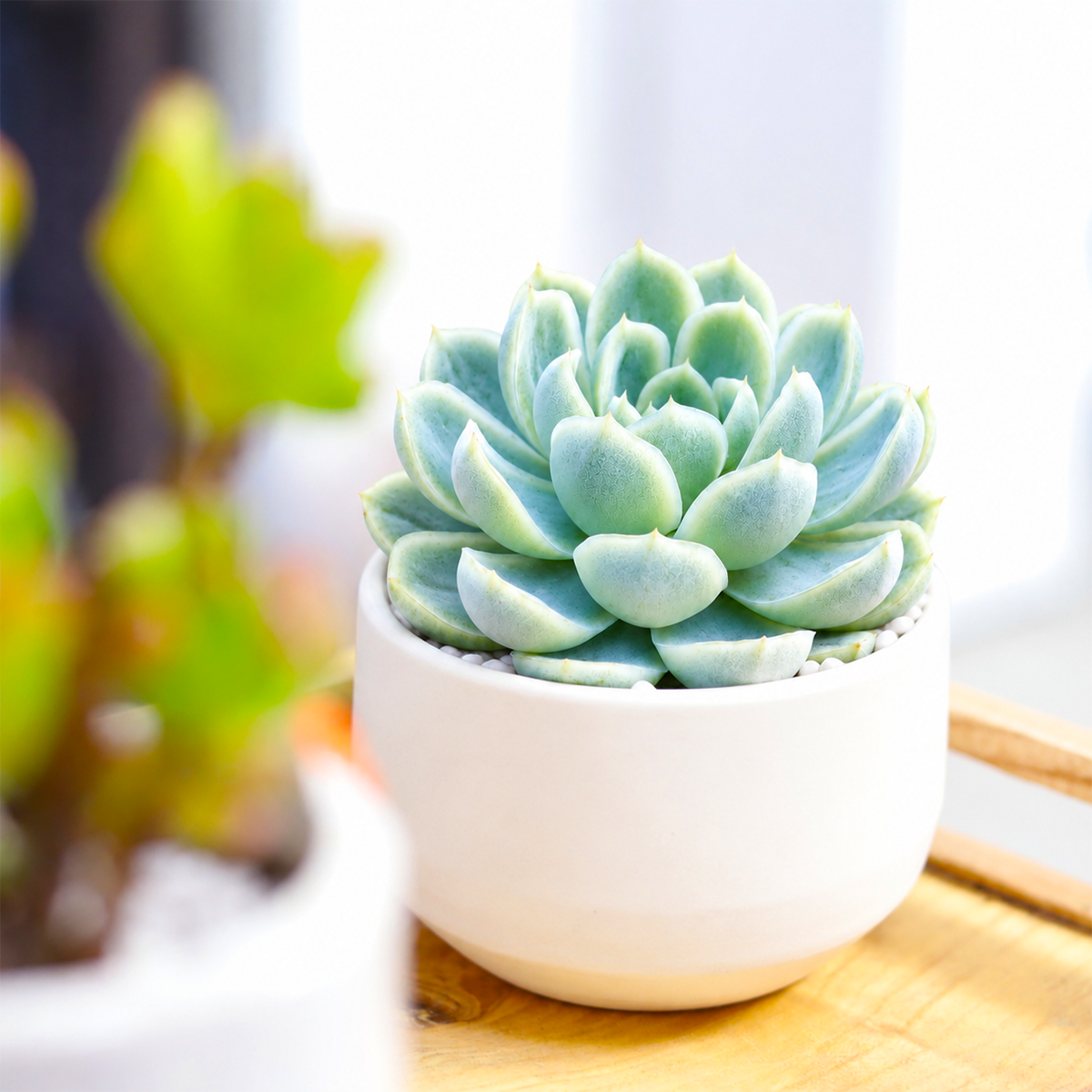
Echeveria elegans, also called Mexican Snowball, is a rosette-forming succulent in the Crassulaceae family native to the semi-arid regions of Hidalgo, Mexico. It grows naturally on rocky hillsides where bright sun, sharp drainage, and dry air define the growing conditions. It forms compact rosettes accessible to growers of all experience levels.
The plant forms tight, symmetrical rosettes of pale blue-green to silvery-gray leaves with gently rounded, spoon-shaped tips and a powdery farina coating that gives it a frosted appearance. Its clustering growth style means a single plant fills out over time, producing offsets that create a dense mound. Available in 2" and 4" sizes, the pale blue-green leaves are easily identified.
Echeveria elegans sends up slender arching stems in late winter to spring, tipped with small pink-to-coral flowers with yellow accents. Blooms are triggered by the natural nighttime temperature drop that comes with seasonal shifts. Rotating the plant regularly during the growing season ensures even, symmetrical rosette development.
You can leave it up to ten days without water. This succulent handles dry heated indoor air well and can be moved outside for summer as long as it is covered from heavy rain. It is pet-friendly, making it safe for households with cats and dogs. The plant propagates easily from the offsets it naturally produces as it clusters, so separate a healthy offset, let the base callous for a day or two, and plant it in fresh well-draining soil.
Echeveria Elegans Mexican Snowball grows in bright indirect light, partial sun, or full sun, though intense south-facing window exposure may scorch the pale leaves.
Echeveria elegans is a slow to moderate grower that benefits from diluted balanced succulent fertilizer once monthly during spring and summer.
Echeveria elegans does best in a well-draining cactus and succulent mix combined with perlite at roughly a 50/50 ratio.
Water it deeply every 10-14 days in summer, reducing to once every 3-4 weeks in winter, allowing soil to dry completely between waterings.
It prefers temperatures between 65-80°F and should be protected from frost below 25°F.


