


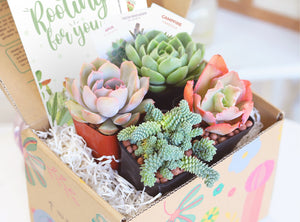
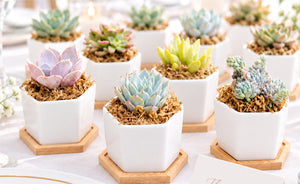
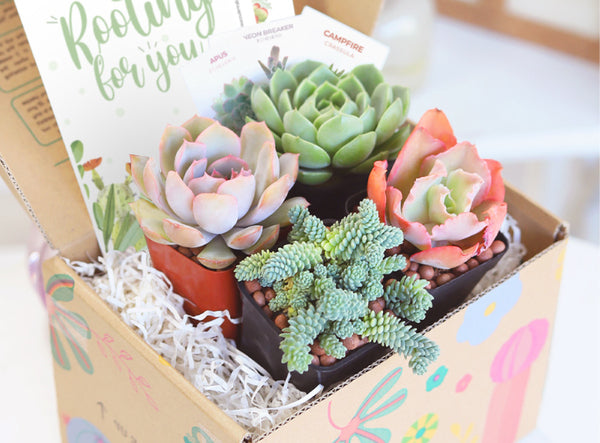


Our November box featuring Echeveria ‘Ice Green’, Powder Puff, Tillandsia Stricta Green, Echeveria ‘Black Soul’, and Aloe Snow.
1. Echeveria ‘Ice Green’

 Echeveria Ice Green is a succulent in the Crassulaceae family, a Korean hybrid of Echeveria species native to semi-arid Mexico. It stores water in its fleshy leaves and grows best in bright, dry conditions.
 It forms a tight, compact rosette of chubby, rounded leaves in frosty pale green, with orange-red tips in cool weather. The leaves have a powdery farina coating that gives an icy sheen and helps it manage heat and light. This compact growth style reaches about 3 to 4 inches in diameter at maturity.
 Echeveria Ice Green produces arching flower stalks with bell-shaped blooms, pink outside and orange inside, typically in spring or early summer. Bloom frequency increases when the plant experiences a natural drop in nighttime temperatures, so moving it outdoors in autumn before bringing it back inside encourages flowering the following season.
 Rotate the pot regularly to keep the rosette growing evenly, and always provide cover from rain to prevent rot. It is pet friendly and non-toxic to cats and dogs. It transitions between indoors and outdoors during summer months. The plant is drought tolerant and comfortable in dry air and low humidity environments. It also makes an excellent outdoor plant for patios, rock gardens, and container arrangements in warm climates.
 Echeveria Ice Green grows well in bright indirect light and may scorch in intense south-facing windows.
 Water it deeply every 10 to 14 days in summer, reducing to once monthly in winter.
Echeveria Ice Green does best in a gritty, well-draining cactus and perlite mix at roughly 50/50.
 It prefers temperatures between 65 to 80°F and is frost-sensitive below 30°F.
 Echeveria Ice Green is a slow grower; feed it monthly in spring and summer with diluted balanced fertilizer.
2. Pachyveria Powder Puff

Pachyveria Powder Puff is a succulent in the Crassulaceae family, a hybrid of Pachyphytum oviferum and Echeveria cante created in the United States in the 1970s. It stores water in its thick, fleshy leaves and grows best in bright, dry conditions.
It forms dense rosettes of plump, powdery silvery-blue leaves that blush pink to violet in full sun or cool weather. The leaves have a thick farina coating that gives a soft, pastel sheen and helps it manage heat and light. Over time it develops short, sprawling stems and reaches about 6 inches tall at maturity.
Pachyveria Powder Puff produces branched flower stalks with clusters of small, bell-shaped apricot blooms, typically in summer. Bloom frequency increases when the plant experiences a natural drop in nighttime temperatures, so moving it outdoors in autumn before bringing it back inside encourages flowering the following season.
Rotate the pot regularly to keep the rosette growing evenly, and always provide cover from rain to prevent rot. It is pet friendly and non-toxic to cats and dogs. It transitions between indoors and outdoors during summer months. The plant is drought tolerant and comfortable in dry air and low humidity environments. It also makes an excellent outdoor plant for patios, rock gardens, and container arrangements in warm climates.
Pachyveria Powder Puff grows well in bright indirect light and may scorch in intense south-facing windows.
Water it deeply every 10 to 14 days in summer, reducing to once monthly in winter.
Pachyveria Powder Puff does best in a gritty, well-draining cactus and perlite mix at roughly 50/50.
It prefers temperatures between 65 to 80°F and is frost-sensitive below 30°F.
Pachyveria Powder Puff is a moderate grower; feed it monthly in spring and summer with diluted balanced fertilizer.
3. Tillandsia Stricta Green
Tillandsia Stricta is one of the more prolific air plants in the Tillandsia Genus. Often growing in large clumps, these plants are known for their beautiful neon pink bloom. The upside is that after Stricta produce their bloom, they begin the process of creating offsets, which will in turn bloom within the next year or two.
 All of the plants may be shipped bare root.
Bright indirect sunlight.
No soil is needed. Sand, sea glass, rocks, pebbles & bark chip can be used instead of soil.
Frequent misting several times a week is necessary. Stricta will also benefit from a soaking bath every week. Give it a little shake off afterwards to make sure water doesn't collect in the bottom leaves to prevent rot.
4. Echeveria ‘Black Soul’

Echeveria Black Soul, also known as Echeveria ‘Cindy’, is a succulent in the Crassulaceae family, a hybrid cultivar from the Echeveria genus native to semi-arid Mexico. It stores water in its fleshy leaves and grows best in bright, dry conditions.
It forms a dense rosette of thick, broad leaves with pointed tips in deep burgundy to wine red, deepening to near black in strong light and cool weather. The smooth leaf surfaces have a subtle sheen, and lower light brings out more green toward the center. This compact growth style reaches about 4 to 5 inches in diameter at maturity.
Rotate the pot regularly to keep the rosette growing evenly, and always provide cover from rain to prevent rot. It is pet friendly and non-toxic to cats and dogs. It transitions between indoors and outdoors during summer months. The plant is drought tolerant and comfortable in dry air and low humidity environments. It also makes an excellent outdoor plant for patios, rock gardens, and container arrangements in warm climates.
Echeveria Black Soul grows well in bright indirect light and may scorch in intense south-facing windows.
Echeveria Black Soul does best in a gritty, well-draining cactus and perlite mix at roughly 50/50.
Water it deeply every 10 to 14 days in summer, reducing to once monthly in winter.
Echeveria Black Soul is a slow to moderate grower; feed it monthly in spring and summer with diluted balanced fertilizer.
It prefers temperatures between 65 to 80°F and is frost-sensitive below 30°F.
5. Aloe 'Snow'
Aloe 'Snow' (Aloe hybrid) is a compact rosette succulent bred from the Aloe genus, part of the Asphodelaceae family. It originates from hybridization programs drawing on South African aloe species, selected for its dense, low-growing form and heavily spotted leaf pattern.
Flower information for this specific cultivar is not widely confirmed, so details on bloom color or season are not included here. What is well documented is that Aloe 'Snow' responds to a nighttime temperature drop, which can encourage flowering when conditions are right. Rotating the pot regularly keeps the rosette growing evenly rather than leaning toward the light source.
Move it outside for the summer months, but keep it covered or sheltered from rain, since the rosette can collect standing water and rot. Indoors, position it away from direct airflow from air conditioners or heaters, though it handles the dry heated air common in most homes. You can leave it up to ten days without water, and the soil signal is simple: wait until the top inch or two is completely dry. Cats, dogs, and small children should not have access to it - the sap causes skin and paw irritation, and the plant should not be ingested; a high shelf works well for keeping it out of reach.
Aloe 'Snow' grows best in bright indirect light, away from intense south-facing windows that can scorch the leaf tips.
Aloe 'Snow' is a slow-growing compact succulent; feed it once in spring and once in summer with a diluted succulent fertilizer.
Aloe 'Snow' does best in a fast-draining cactus or succulent mix, with added perlite for extra drainage.
Water it every 10-14 days in the growing season, letting the soil dry out completely between waterings.
It prefers temperatures between 60-80°F and should stay above 50°F, as it does not tolerate frost.


