


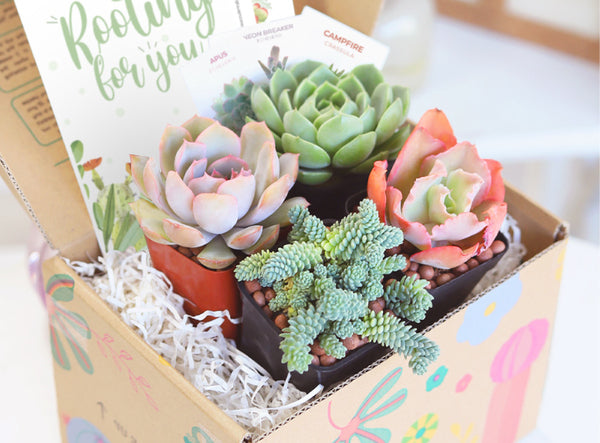
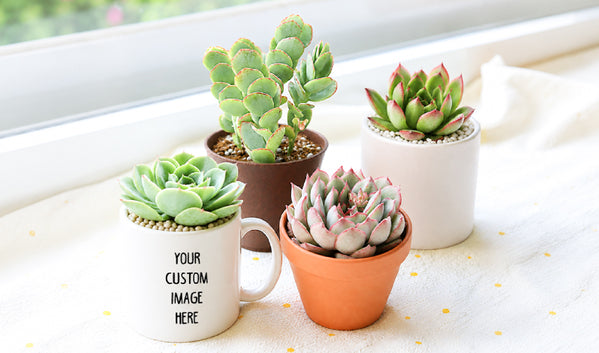



Our May box featuring Echeveria Blue Fairy, Crassula Tom Thumb, Mammillaria Spinosissima Cactus, and Echeveria Compressicaulis.
1. ECHEVERIA BLUE FAIRY
 The lovely Echeveria Blue Fairy is one of best selling succulents, and with good reason. This rosette has blue green foliage, and sometimes the pointed tips have a reddish color.
 Loves bright light, produces offsets randomly for new plants, and has these wonderful blooms with colorful flowers. The blooms can get up to 8 inches long.
 Make sure the soil is moist at all times during the spring and summer months.
 Water when soil is dry to the touch, which is approximately every 7 - 10 days. Avoid water it daily. Water them more in spring and summer and less in winter, and it’s better to underwater them than overwater them.
 Feed once with a weak fertilizer at the beginning of the growing season (Spring or Summer).
2. CRASSULA TOM THUMB
 Crassula Tom Thumb is a cute miniature succulent that grow trailing branches, making them a great addition for hanging planters. It has tiny densely packed triangular leaves that can develop red edges with enough sun exposure.
 It's not frost tolerant and needs protection in the winter to avoid scarring.
 In spring, it produces tiny white flowers as cute as the mother plant.
 Sun to Partial Shade, Light Shade.
 Water thoroughly when soil is dry to the touch, then let drain completely. Avoid letting water sit for too long in the soil to prevent rot and fungal diseases. Reduce watering in the winter.
 Well-Drained, Porous, Gritty. Optimal pH is around 6.0 (slightly acidic).
 Average summer temperatures from 65ºF/18ºC to 70ºF/21ºC are ideal. In winter, it can survive temperatures as low as 50ºF/10ºC.
 Feed once with a controlled-release fertilizer at the beginning of the growing season.
3. MAMMILLARIA SPINOSISSIMA CACTUS
 Mammillaria Spinosissima Cactus is also known as Red-headed Irishman with cylyndrical, dark green stem, up to 12 inches (30 cm) tall and up to 4 inches (10 cm) in diameter, almost hidden under a dense covering of spines. Flowers are purplish or deep-pink in spring. The Red-Headed Irishman will do best outdoors, though it may be kept indoors as well. Bright light, full sun to partial shade. Water thoroughly when soil is dry to the touch, then let drain completely. Reduce watering in the winter. Porous and well-drained cactus mix. Feed with a cacti fertilizer mix during the growing season.
4. ECHEVERIA COMPRESSICAULIS
 Echeveria Compressicaulis is a small succulent with sprawling stems that can grow up to 8 inches tall. Their leaves are dark brownish-green to purplish-green and arranged into a rosette-like cluster towards the stem tips Its flowers are bell-shaped, lovely orange-yellow with lighter petal margins Full Sun, Filtered Sun, Part Shade. Porous and well-drained succulent mix . Avoid letting water sit for too long in the rosette to prevent rot and fungal diseases. .
 Dead leaves should be removed from the plant as soon as possible to ward off pests.


