


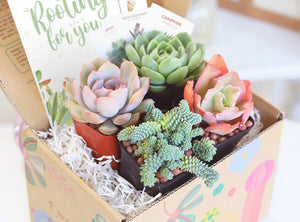
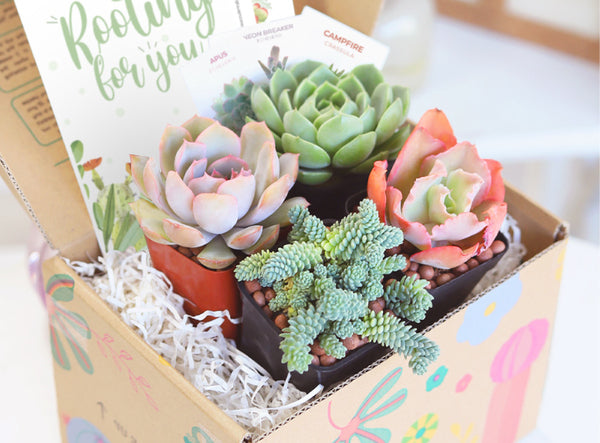


Our July box featuring Echeveria ‘Blue Prince’, Tylecodon Schaeferianus, Adromischus Cristatus, California Sunset and Tillandsia Ionantha Rubra
1. Echeveria ‘Blue Prince’
 Echeveria 'Blue Prince' is a stunning rosette succulent in the Crassulaceae family, beloved by collectors and beginners alike as a low maintenance succulent that's genuinely easy to grow. Like most echeverias, it traces its roots to the semi-arid highlands of Mexico and Central America, where it evolved to thrive in bright light and well-drained soils.
 Echeveria 'Blue Prince' forms tight, symmetrical rosettes of thick, fleshy leaves coated in a powdery farina that gives them their signature blue-green color with soft, silvery-lavender undertones. The leaf tips are gently pointed, the edges flush with a subtle blush, and the whole plant has that satisfying sculptural quality that makes the blue prince succulent so instantly recognizable. Over time, Echeveria 'Blue Prince' develops a clustering habit, producing offsets that fill out a pot beautifully.
 Echeveria 'Blue Prince' typically sends up arching flower stalks bearing small, coral-to-orange bell-shaped blooms, most commonly in spring or early summer. A key trick to encourage blooming is providing a nighttime temperature drop, which signals the plant that it's time to flower. The blooms attract pollinators and add a cheerful pop of warm color above those cool blue-green rosettes.
 Echeveria 'Blue Prince' is a dream pick for sunny windowsills, patio containers, and mixed succulent arrangements, and its easy care nature makes it a top recommendation for first-time succulent growers. It's a pet friendly succulent, so no worries if a curious cat takes a sniff. This blue green succulent is hardy enough to survive a 10-day trip without a caretaker, tolerates the dry heated air of indoor environments, and can even move outside for summer to soak up extra sun, just be sure to cover it from heavy rain or bring it under shelter.
 Echeveria 'Blue Prince' thrives in bright indirect light to full sun, needing at least 4-6 hours of direct or bright light daily.
 Water Echeveria 'Blue Prince' thoroughly every 10-14 days in summer and every 3-4 weeks in winter, always letting the soil dry out completely between waterings.
Echeveria 'Blue Prince' does best in a fast-draining cactus and succulent mix blended with extra perlite or coarse grit for optimal drainage.
 Echeveria 'Blue Prince' prefers temperatures between 65-80°F (18-27°C) and should be protected from frost, as it is not cold-hardy below about 25-30°F (-4 to -1°C).
 Echeveria 'Blue Prince' is a slow to moderate grower that benefits from a diluted balanced succulent fertilizer applied once a month during the active growing season.
2. Tylecodon Schaeferianus
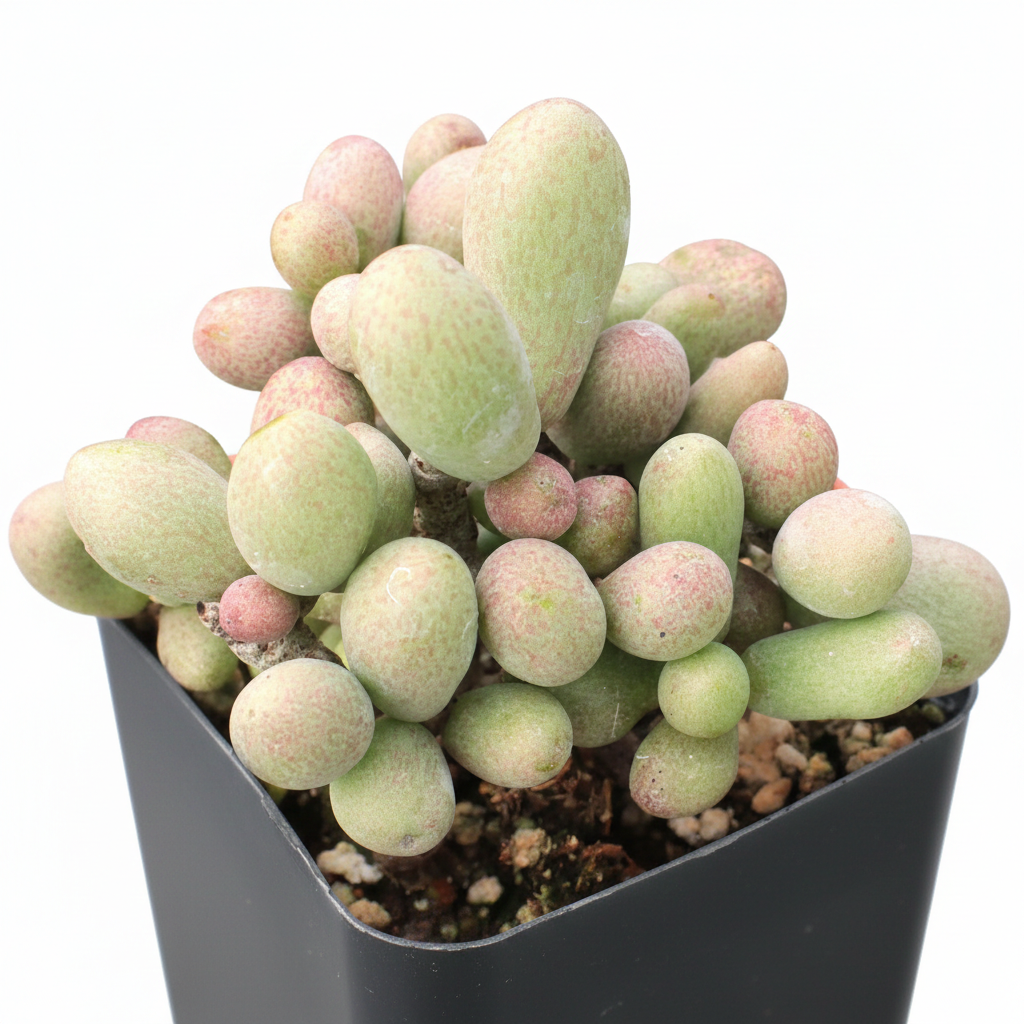
The Tylecodon schaeferianus, affectionately known as the "Fairy Tale Plant," is a miniature succulent that looks like it belongs in a fantasy forest. It is a "caudiciform" or pachycaul plant, meaning it develops a thick, swollen, and gnarled base (caudex) with peeling, papery bark. From this ancient-looking trunk, tiny, egg-shaped green leaves emerge, giving it the appearance of a microscopic, weathered tree.
This rare gem hails from the arid, rocky regions of Namibia and the Namaqualand in South Africa. It is a desert specialist, having evolved to store water in its woody trunk to survive the harsh, dry winters of its native habitat.
Bright Indirect Light. It loves light but can be sensitive to intense, direct afternoon sun which may scorch its tiny leaves.
Extremely Gritty/Inorganic. Use a mix of pumice, lava rock, and coarse sand. It requires maximum drainage to protect the caudex.
Careful & Seasonal. This is a winter grower. Water more regularly in autumn/winter when leaves are present, and keep nearly bone-dry in summer dormancy.
3. Adromischus Cristatus
Key Lime Pie - Adromischus cristatus - Crinkle-Leaf Plant is a rare succulent in the Crassulaceae family, native to the rocky outcrops and dry slopes of South Africa's Eastern Cape. This charming adromischus cristatus has become a collector favorite, prized for its quirky character and genuinely easy care.
The key lime pie succulent earns its delightful name from its thick, wedge-shaped leaves edged with distinctive crinkled, wavy margins that look almost ruffled. Key Lime Pie - Adromischus cristatus - Crinkle-Leaf Plant forms compact rosettes that cluster over time, producing a low, upright mounding habit in soft grey-green tones dusted with fine white hairs. Each leaf is plump and textured, making this crinkle leaf succulent instantly recognizable among rare succulents.
Crinkle-Leaf Plant is primarily grown for its extraordinary foliage rather than its blooms, and that textured, ruffled leaf margin is the true showpiece. The clustering rosette habit means one plant gradually fills a pot with sculptural, layered growth that gets more impressive each season.
This crinkle leaf plant is a standout on a sunny windowsill, a patio display, or a curated rare succulent collection. Key Lime Pie - Adromischus cristatus - Crinkle-Leaf Plant can move outside for summer but needs cover from rain, as sitting water on the leaves causes rot. It survives a 10-day trip alone without water, making it genuinely low-maintenance, and it shows you when it is thirsty through slight leaf wilting so you never have to guess. Rotate it regularly for even, balanced rosette growth.
Key Lime Pie thrives in bright indirect light to partial sun, though it can handle full sun if acclimated gradually.
Key Lime Pie is a slow grower needing only a light, balanced succulent fertilizer once or twice during the active spring and summer season.
It needs fast-draining succulent or cactus mix blended with perlite or coarse grit for best results.
Water Crinkle-Leaf Plant deeply every 10-14 days in summer, pulling back to once a month in winter.
Crinkle-Leaf Plant prefers temperatures between 50-80°F (10-27°C) and should be brought indoors before nights drop below 40°F (4°C).
4. California Sunset
Graptosedum California Sunset is a stunning drought tolerant succulent and a hybrid within the Crassulaceae family, combining traits from both Graptopetalum and Echeveria genera. It thrives naturally in warm, dry climates and has become a favorite for collectors and beginners alike thanks to its easy care and gorgeous coloring.
Graptosedum California Sunset forms compact rosettes that cluster and trail beautifully over time, making it a versatile pick for pots, shelves, or hanging displays with a trailing hook. The thick, spoon-shaped leaves shift through a breathtaking range of orange, pink, purple, and gray tones depending on sun exposure and temperature, with the most vibrant color showing up under bright direct sun.
Graptosedum California Sunset needs a nighttime temperature drop to trigger blooming, so moving it outdoors in summer or placing it near a cool window in autumn can reward you with seasonal flowers. Beyond its blooms, the clustering rosette habit and ever-shifting leaf palette keep this plant visually exciting all year long.
 Graptosedum California Sunset is a true beginner-friendly succulent that survives a 10-day trip without a sitter, tolerates dry heated indoor air, and bounces back from neglect with ease. It loves spending summer outdoors but needs cover from rain to prevent rot, and it should be rotated regularly so every rosette gets even light exposure. Keep it away from AC or heater vents to avoid stress from blasting air. Pet owners will be happy to know this plant is pet friendly, and its compact trailing growth makes it equally at home on a sunny windowsill, a patio table, or in a mixed succulent arrangement.
Graptosedum California Sunset thrives in bright indirect light, partial sun, or full direct sun for the richest color.
Graptosedum California Sunset does best in a gritty, well-draining cactus and perlite mix to prevent root rot.
Water Graptosedum California Sunset deeply every 10-14 days in summer and pull back to once a month in winter.
Graptosedum California Sunset is a moderate grower that benefits from a light balanced fertilizer once in spring and once in early summer.
Graptosedum California Sunset prefers temperatures between 65-85°F (18-29°C) and should be protected from frost below 25°F (-4°C).
5. Tillandsia Ionantha Rubra

Tillandsia Ionantha Rubra is a compact, eye-catching air plant in the Bromeliaceae family. It forms a tight, symmetrical rosette of spiky, silvery-green leaves covered in fine trichomes. As it approaches its bloom cycle or receives strong light, the center leaves blush a vibrant crimson red, creating a stunning contrast with its tubular violet-purple flowers.
 All of the plants may be shipped bare root.
Bright filtered light.
No soil is needed. Sand, sea glass, rocks, pebbles & bark chip can be used instead of soil.
Frequent misting several times a week is necessary. Rubra will also benefit from a soaking bath every month. Give it a little shake off afterwards to make sure water doesn't collect in the bottom leaves to prevent rot.


