




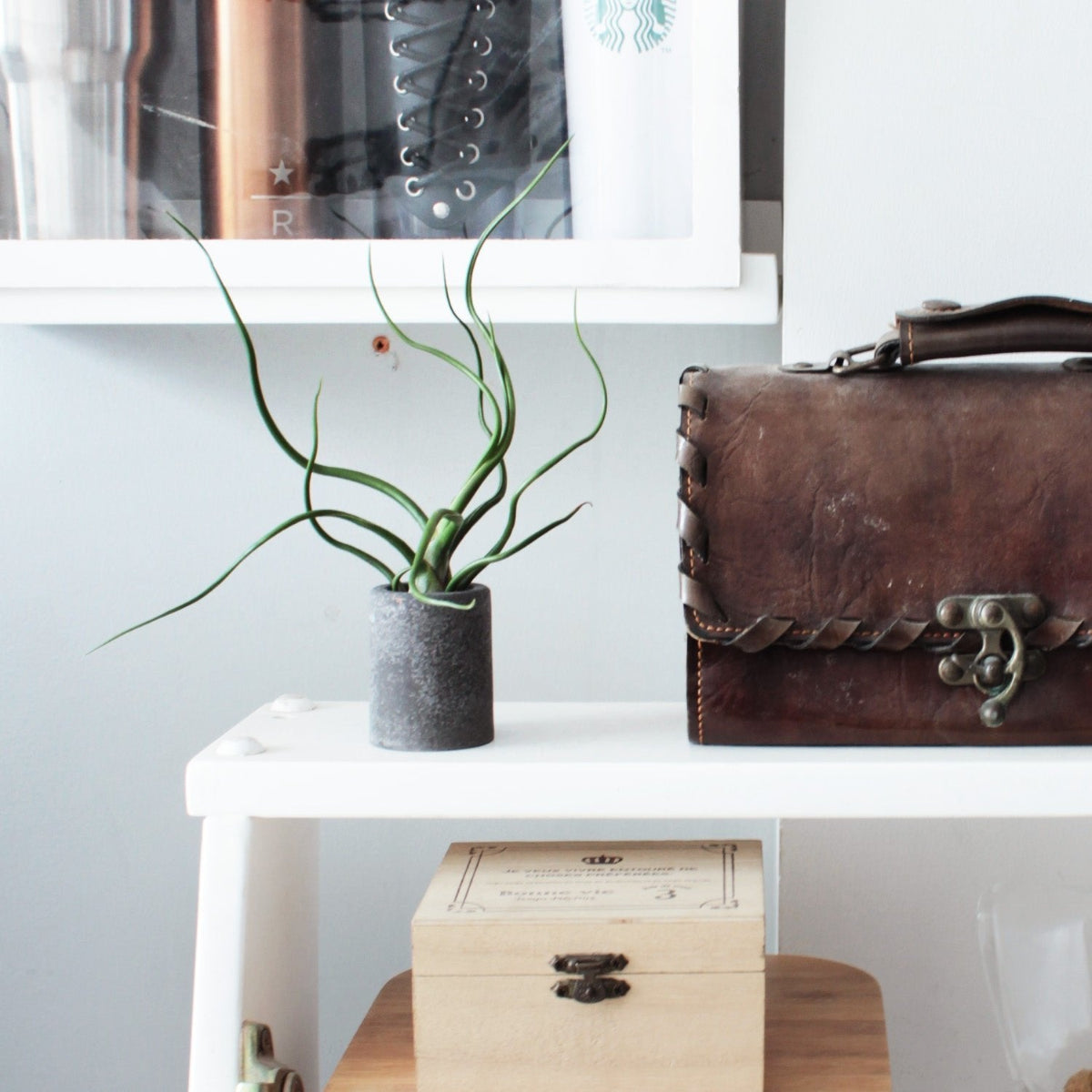
Tillandsia Bulbosa Belize is an unusual air plant recognized by its large bulbous base and long, narrow leaves that twist and curl in different directions. The foliage is typically bright to deep green with a smooth, waxy appearance, giving mature plants a distinctive tentacle-like form.
It is commonly sold as the Belize form of Tillandsia bulbosa rather than as a separate botanical species. Tillandsia bulbosa is an accepted species in the Bromeliaceae family and occurs naturally throughout tropical America, including Belize, Mexico, Central America, the Caribbean, and northern South America. It grows as an epiphyte in wet tropical habitats, attaching itself to trees and other surfaces rather than growing in soil.
The Belize form is known for growing larger than the more compact Guatemala form. Mature plants commonly develop long curling leaves from a pronounced hollow base, and the upper foliage can turn red as flowering approaches. Bright violet-purple tubular flowers then emerge from colorful red bracts.
This guide covers everything you need to know about Tillandsia Bulbosa Belize care, including lighting, watering, airflow, temperature, humidity, fertilizer, mounting, propagation, blooming, and common problems.

Basic Information
| Feature | Details |
|---|---|
| Botanical Name | Tillandsia bulbosa var. belize |
| Family | Bromeliaceae |
| Plant Type | Air plant (Epiphytic succulent) |
| Mature Size | 6 to 10 inches tall |
| Sun Exposure | Bright, indirect light |
| Soil Type | None, grown without soil |
| Soil pH | Not applicable, grown without soil |
| Bloom Time | Late spring to early summer |
| Flower | Purple-red tubular flowers |
| Hardiness Zones | 10 to 11 |
| Native Area | Central America, Belize |
| Toxicity | Non-toxic to pets and humans |
Should we grow Tillandsia Bulbosa Belize indoors or outdoors?
Indoors, Tillandsia Bulbosa Belize does beautifully near a bright window where it gets filtered light throughout the day. It's forgiving of typical indoor air and can add a unique sculptural element to any room.
Outdoors, this air plant thrives in warm climates (zones 10 to 11) where it won't face frost or hard freezes. It loves the natural air circulation and humidity of outdoor spaces, though it still needs protection from intense afternoon sun.
General Care
1. Lighting
Tillandsia Bulbosa Belize prefers bright, filtered light.
Indoors, place it near an east-facing or bright west-facing window where it receives plenty of indirect sunlight. A south-facing window can also work if harsh midday sun is filtered through a sheer curtain.
Its green foliage has fewer visible trichomes than many silver-gray air plants, making it less adapted to intense sun. Strong direct afternoon sunlight can cause brown or bleached patches on the leaves.
A little gentle morning sun can be beneficial, but introduce stronger light gradually.
2. Watering
Tillandsia Bulbosa Belize appreciates regular hydration, but its bulbous base makes careful drying especially important.
Mist the plant thoroughly several times a week, particularly during warm, dry weather. An occasional soak can also provide deeper hydration. Succulents Box recommends frequent misting during active growth along with a monthly soaking bath.
After watering, gently shake the plant to remove trapped moisture and place it upside down or at an angle until completely dry.
Never allow water to remain inside the bulbous base or between the lower leaves. Trapped moisture can quickly lead to rot.
Watering frequency should always be adjusted to your environment. Plants in hot, dry rooms may need more frequent hydration, while plants in humid conditions generally need less.
3. Soil & Fertilizer
Tillandsia Bulbosa Belize does not need soil.
Like other air plants, it absorbs moisture and nutrients mainly through specialized structures on its leaves. The roots are primarily used to anchor the plant to trees or other surfaces.
Do not bury the bulbous base in potting soil, moss, or another moisture-retentive material. Keeping the base exposed allows it to dry more efficiently after watering.
During active growth, use a diluted bromeliad or air plant fertilizer approximately once a month. Apply it at low strength because excessive fertilizer can damage the leaves.
Reduce feeding during cooler months when growth slows.
4. Temperature & Humidity
Tillandsia Bulbosa Belize prefers warm temperatures and moderate to high humidity.
Normal indoor temperatures around 60 to 85°F work well. Protect the plant from frost, cold drafts, and sudden temperature changes.
Because Tillandsia bulbosa naturally grows in wet tropical environments, it generally appreciates more atmospheric moisture than many silver-leaved, drought-adapted air plants.
However, humidity should always be balanced with good airflow. High humidity combined with stagnant air can prevent the bulbous base from drying and increase the risk of rot.
Avoid keeping it directly beside heaters or air-conditioning vents.
5. Toxicity
Tillandsia air plants are generally considered non-toxic to cats and dogs, although there is limited species-specific toxicology information for Tillandsia Bulbosa Belize.
Pets should still be discouraged from chewing the plant. Eating plant material may cause digestive discomfort, and the narrow leaves can easily be damaged.
Keep fertilizers and any adhesives used for mounting out of reach of pets as well.
Extra Care
1. Potting & Repotting
Tillandsia Bulbosa Belize does not require traditional potting or repotting.
Its unusual twisting form works particularly well mounted on driftwood, cork bark, stones, shells, or an open air plant holder.
When mounting the plant, keep the bulbous base exposed and preferably position it at a slight angle so water can drain easily after watering.
Avoid placing it deeply inside glass globes, narrow containers, or decorative vessels where moisture can remain trapped around the base.
If using plant-safe glue or wire, attach only the lower exterior portion of the plant and avoid damaging the living tissue.
2. Pruning
Very little pruning is required.
Remove only completely dry or damaged leaves. Brown leaf tips can be carefully trimmed with clean scissors if desired, following the natural shape of the leaf.
After flowering, the old flower stalk can be removed once it becomes completely dry.
Do not cut healthy green leaves simply to reshape the plant. Its twisting, irregular growth is a natural characteristic of Bulbosa Belize.
3. Propagation
Tillandsia Bulbosa Belize reproduces through offsets, commonly called pups.
After flowering, small pups begin developing around the base of the mother plant. This is a normal part of the air plant life cycle.
Allow pups to remain attached until they reach approximately one-third to one-half the size of the parent before separating them. They can also be left attached to create a larger clump over time.
To separate a pup, gently twist it away from the parent or use a clean blade if necessary.
Care for separated pups just like mature plants, with bright filtered light, regular hydration, and good airflow.
4. Blooming
Blooming is one of the most dramatic stages of Tillandsia Bulbosa Belize growth.
As a mature plant prepares to flower, its upper green leaves may gradually turn bright red or reddish-purple. A colorful flower spike then develops with red bracts and tubular violet-purple flowers.
Each individual air plant blooms only once in its lifetime. After flowering, the parent plant gradually begins producing pups and will slowly decline over time.
This does not mean the plant dies immediately after flowering. The mother plant can remain healthy for many months while supporting its offsets.
Bright filtered light, regular watering, warm temperatures, and occasional fertilizer can support healthy growth and flowering, but there is no need to force the bloom cycle.
5. Seasonal Care Tips
- Fall and Winter: Growth slows down during cooler months, so reduce fertilizing and maintain your regular misting routine. Keep the plant away from cold drafts and heating vents that dry out the air, and bring outdoor plants inside if temperatures drop near 50°F.
- Spring & Summer: This is the active growing season, so mist more frequently if your home is particularly dry and feed monthly with diluted bromeliad fertilizer. Watch for the emergence of flower buds and pups during this time.
Common Problems
The most common issue with air plants is getting their watering routine wrong. If the leaves look gray or papery, the plant isn't getting enough moisture. If the center turns mushy or brown, it's sitting too wet and doesn't have enough air circulation. Brown leaf tips can result from chlorinated water or low humidity. Always make sure your plant dries out within a few hours after misting or soaking, and improve air flow by positioning it where there's gentle movement around its leaves.
Succulents Box's Tips
- Mist your Tillandsia Bulbosa Belize in the morning so it has all day to dry before evening, reducing the risk of rot.
- Group it with other air plants and bromeliads for a striking living display that celebrates their sculptural forms.
- If you live in a dry climate or have dry indoor air, soak weekly rather than just misting to ensure it's getting enough hydration.
- Mount it on cork or driftwood and hang it near a window for a gallery-like effect that shows off its curled leaves beautifully.
- Keep a spray bottle of water nearby for quick misting between your scheduled watering days during hot or dry spells.


