


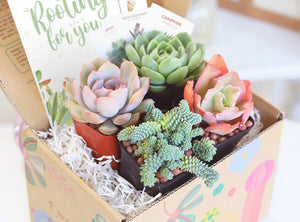
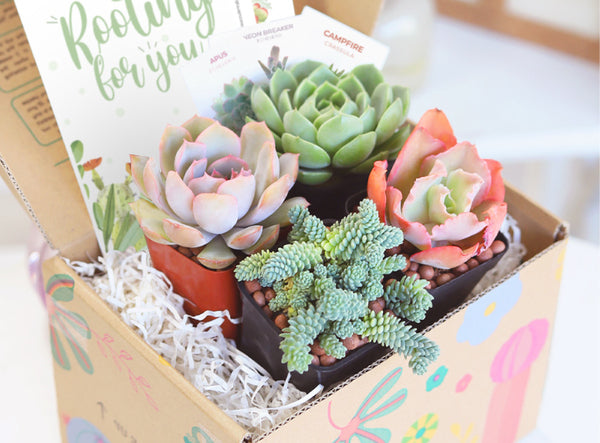
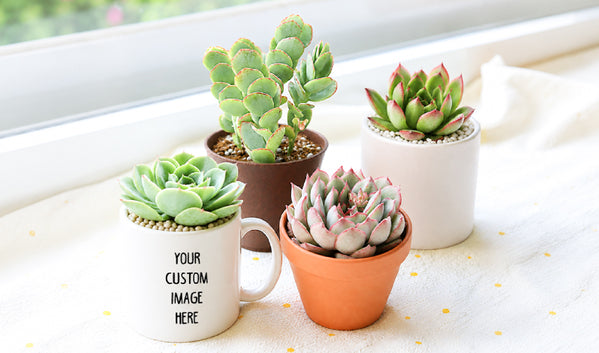


Our December box featuring Crassula rubricaulis 'Candy Cane', Echeveria Compressicaulis, Echeveria Cubic Frost, Crassula Rupestris var. Monticola and Tillandsia Juncifolia.
1. Crassula rubricaulis 'Candy Cane'

 Crassula Rubricaulis Candy Cane is a rare succulent with beautiful green and white variegation. It bushes rosy red in full sun like a candy cane.
 It displays tiny white blooms in mid-summer.
 Plants may be shipped bare root.
 Full sun to partial shade.
 Well-Drained, Porous, Gritty. Optimal pH is around 6.0 (slightly acidic).
 Average summer temperatures from 65ºF/18ºC to 70ºF/21ºC are ideal. In winter, it can survive temperatures as low as 50ºF/10ºC.
 Water thoroughly when soil is dry to the touch, then let drain completely. Avoid letting water sit for too long in the soil to prevent rot and fungal diseases. Reduce watering in the winter.
 Feed once with a controlled-release fertilizer at the beginning of the growing season.
 You can propagate Crassula Rubricaulis Candy Cane by division, offsets or leaf cuttings. The easiest way is to propagate from a single leaf: put the leaf in a succulent or cacti mix, then cover until it sprouts.
2. Echeveria Compressicaulis
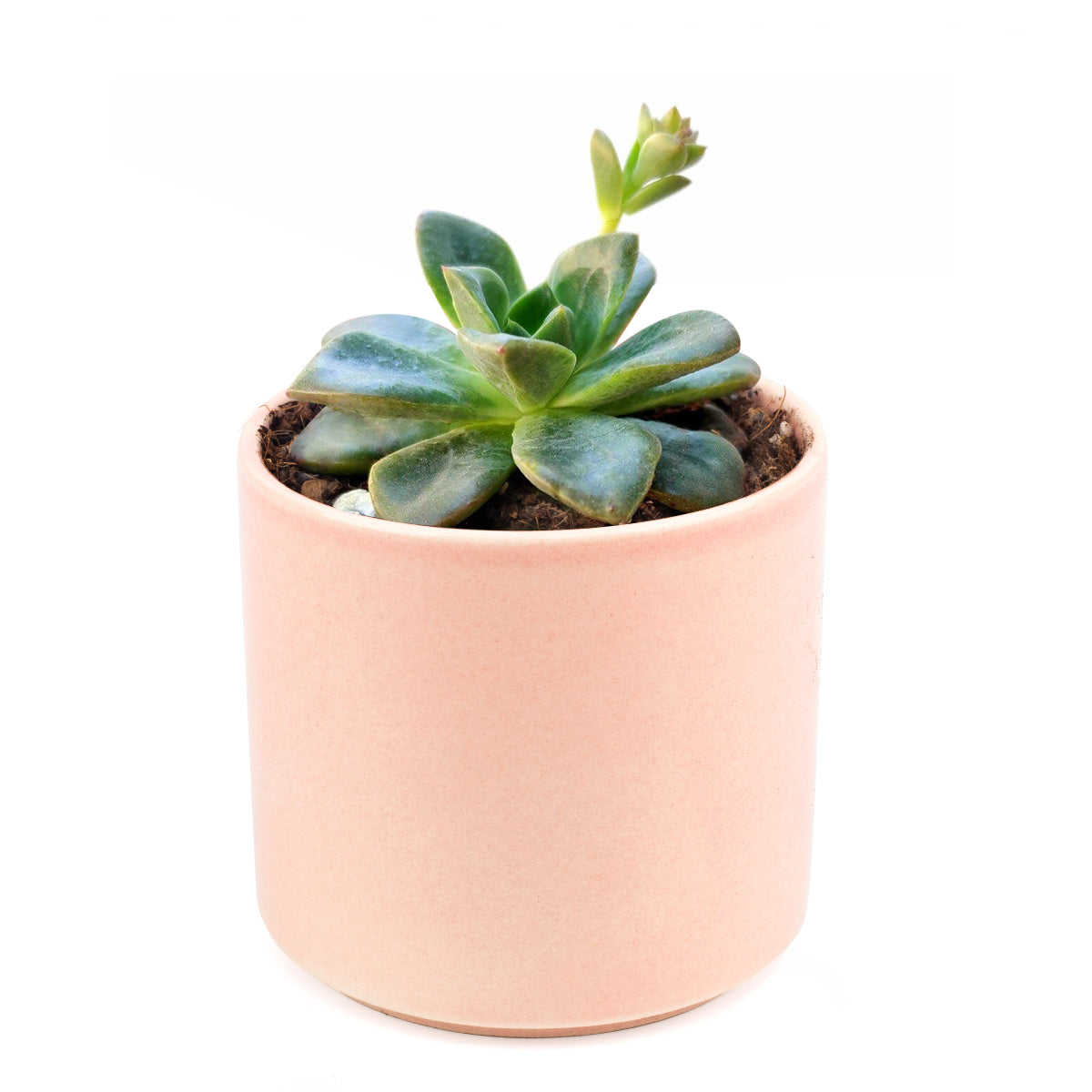
Echeveria compressicaulis is a species from Venezuela. A species with thick, fleshy leaves. It takes on very deep-red colours under strong light. Rather than grow low like most Echeveria, this one will grow upwards and offset from the stem
When it flowers you can expect it to produce bell-shaped orange flowers.
Plants may be shipped bare root.
Make sure the soil is moist at all times during the spring and summer months.
Water when soil is dry to the touch, which is approximately every 7 - 10 days. Avoid water it daily. Water them more in spring and summer and less in winter, and it’s better to underwater them than overwater them.
It thrives best in full sun to light shade. In order to develop their foliage color, you should place Echeveria Compressicaulis somewhere is a warm, sunny with well-drained soil. In the indoor and east or west-facing window where it can receive four to six hours of sunlight is ideal.
 Generally non-toxic to humans and animals.
3. Echeveria Cubic Frost
Echeveria Cubic Frost is a stunning succulent with silver-coated lilac leaves that turn baby pink with lots of sun exposure. The leaves are distinctively upturned, pointy, symmetrical, and fleshy. This species grows quickly and can produce offsets freely, creating attractive clusters of lavender rosettes that can get up to 10 inches in diameter.
In late spring to early summer, it produces lovely coral bell-shaped flowers.
All of the plants may be shipped bare roots.
Bright Light, Full Sun.
Fast Draining.
April to August.
Avoid letting water sit for too long in the rosette to prevent rot and fungal diseases.
 Dead leaves should be removed from the plant as soon as possible to ward off pests.
4. Crassula Rupestris var. Monticola
Crassula Brevifolia, native to South Africa, has thick, fleshy, triangulated green leaves with a rough, fuzzy texture borne on woody branches.
 It grows small shrubs of up to 20 inches (50 cm) tall. The leaves will get a red-brown margin in full sun.
Pale pink flower clusters bloom in early fall.
 All of the plants may be shipped bare root.
Porous and well-drained. Optimal pH is around 6.0 (slightly acidic).
Full Sun, Sun to Partial Shade, Light Shade.
Average summer temperatures from 65ºF/18ºC to 70ºF/21ºC are ideal. In winter, it can survive temperatures as low as 50ºF/10ºC.
Water thoroughly when soil is dry to the touch, then let drain completely. Avoid letting water sit for too long in the soil to prevent rot and fungal diseases. Reduce watering in the winter.
Feed with a controlled-release fertilizer at the beginning of the growing season.
You can propagate Crassula Brevifolia by division, offsets or leaf cuttings. The easiest way is to propagate from a single leaf: put the leaf in a succulent or cacti mix, then cover until it sprouts.
5. Tillandsia Juncifolia
Tillandsia Juncifolia, a hybrid between the Juncea and Filifoliaspecies., is a drought-tolerant and easy to grow air plant. Tillandsia juncifolia is a desirable variety of juncea, with greener leaves and considerably larger stolons when producing pups.
All of the plants may be shipped bare root.
Bright, sunny conditions.
No soil is needed. Sand, sea glass, rocks, pebbles & bark chip can be used instead of soil.
Simply soak for a maximum of ten minutes in water once every one to two weeks and hang upside down to dry completely.


