-
-
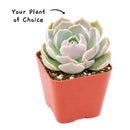
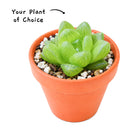
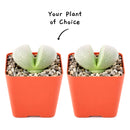
![]() Cotyledon 'Little Queeny' is a rare drought-tolerant succulent from South Africa's rocky outcrops and arid regions. It belongs to the pig's ear family and grows as a compact rosette with a slow habit.
Cotyledon 'Little Queeny' is a rare drought-tolerant succulent from South Africa's rocky outcrops and arid regions. It belongs to the pig's ear family and grows as a compact rosette with a slow habit.
 Little Queeny has thick, paddle-shaped leaves coated in a chalky white finish. The fleshy leaves form tight rosettes with red edges that deepen when exposed to bright light. It maintains a neat, geometric form that stays compact for years, typically reaching 6–8 inches tall and wide.
 During late winter to early spring, it sends up tall stems bearing tubular coral-red bell flowers that contrast sharply against the white foliage. These blooms extend 12–18 inches above the rosette and attract hummingbirds.
 Little Queeny is suitable for containers, rock gardens, and drought-tolerant landscapes. Propagate it easily from leaf or stem cuttings allowed to callus before planting in well-draining soil. Keep it away from cats and dogs, as it is toxic to pets.
-
 Cotyledon 'Little Queeny' grows well in bright, indirect light or morning sun with afternoon shade protection.
 Water it deeply every 10–14 days during the growing season, allowing soil to dry completely between waterings.
 Little Queeny does best in well-draining cactus mix or sandy soil with excellent drainage.
 It prefers temperatures between 65–80°F and tolerates light frost down to 30°F.
![]() Little Queeny is a slow-growing succulent requiring minimal fertilizer; apply diluted succulent food monthly in spring only.
Little Queeny is a slow-growing succulent requiring minimal fertilizer; apply diluted succulent food monthly in spring only.
 It is hardy in USDA zones 9–11 and tolerates brief frost to 30°F. It grows outdoors in Florida, California, Texas, Arizona, Hawaii, Louisiana, Georgia, South Carolina, Nevada, southern Alabama, Mississippi, and coastal regions of North Carolina and Oregon. Container growing extends its range to cooler climates where it can be moved indoors during winter.
-
Q: How often should I water Cotyledon 'Little Queeny'?
A: During the growing season, let soil dry completely between waterings. Reduce watering to once monthly in winter when growth slows.
Q: Is it safe for pets?
A: No. Cotyledon 'Little Queeny' is toxic to cats and dogs and should be kept out of their reach.
Q: What light does Little Queeny need to avoid leaf scorch?
A: Morning sun with afternoon shade works best. Direct afternoon sun can bleach or scorch the chalky white leaves, especially in hot climates.
Q: How fast does it grow?
A: Little Queeny grows slowly and stays compact for years, requiring repotting only every few seasons.
Q: Can you propagate Little Queeny from leaf cuttings?
A: Remove healthy leaves and allow them to callus for several days in a dry location before placing them on well-draining soil. Stem cuttings also root readily.
Q: How large does it get?
A: Little Queeny typically reaches 6–8 inches tall and wide, with flower stems extending 12–18 inches during the blooming season.
-
Hand-Packed with Care: Using recyclable wraps and crinkle paper, we ensure every succulent arrives healthy and in perfect condition.
Processing: Shipped within 3-5 business days (Mon-Fri) year-round.
Urgent Orders: Message us for shipping upgrades (additional cost).
Destinations: We ship succulents to all 50 US states and territories, with the exception of Guam.
Cold Weather: If under 40°F, please add a Heat Pack to your order for safety.
🌵 For Succulents
When your package arrives, you may notice a bit of loose soil in the box. This is completely normal during shipping.
Please remove your plants from their packaging right away and follow the care instructions included with your order. Succulents prefer to dry out between waterings, so only water when the soil is completely dry.
Succulents are resilient plants and typically recover quickly once they settle into their new environment. Give them a few days to adjust before placing them in direct sunlight, and avoid fertilizing right away.
*** We pack carefully to protect each plant during transit, so larger orders may arrive in multiple packages
-
🌿 14-Day Satisfaction Guarantee (Replacement or Refund)
From arrival to long-term care, we’ve got you covered. We carefully pack every plant so it arrives happy and healthy. If something doesn’t look right when it gets to you, don’t worry, we’ll make it right.
How it works:
- Reach out within 14 days of delivery
- Send us your order number and a couple of photos of your plant(s)
- We’ll take care of you with a replacement or a refund
👍 Green Thumb Guarantee (6-Month Extended Coverage)
Still getting the hang of plant care? You’re not on your own. For up to 6 months from your order date, if your plants show serious decline or fail to survive, we’re here to help.
You can claim a gift card to help you continue your plant journey.
How it works:
- This coverage continues after the 14-day guarantee
- Gift card value starts at $15, with the opportunity for more based on your order
- Total gift card value is capped at $50 per order
- One claim per order or subscription
- Gift cards are valid for 6 months from the date of issue
- Just send your order number and a few photos of your plant(s) to support@succulentsbox.com, and we’ll take it from there.
-
1,000+ Plants, the Largest Selection Online. 600+ succulents, 400+ houseplants, and 70+ air plants, all carefully selected and professionally grown.
Plants That Are Ready to Thrive. Every plant is inspected for health and disease before it leaves our nursery, then shipped on schedule so it arrives fresh. The best plant quality you'll find online.
Gifts and Subscriptions for Any Occasion. 30+ themed gift boxes and 1, 3, 6, or 12-month subscriptions.
14-Day Satisfaction Guarantee. Something not right? Send us your order number and photos and we'll fix it.
6-Month Green Thumb Coverage. The longest guarantee in the industry. If your plant seriously declines, we're still here for you.
Real People, Real Answers. No chatbots. Our team responds within 24 hours. Over 15,000 five-star reviews, and our customers say we have the best customer service in the plant industry.

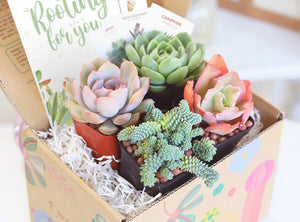
 Arrives healthy & gift-ready
 Healthy plant or replaced free
 Plant care guide included with every gift Plus live plant doctor access